

Disclaimer: The content on Sprout Upward is designed to encourage intentional family leadership. I am a mom of two and a former youth worker sharing my real-life experiences, not a licensed therapist or medical professional. These guides adapt my professional team management background to daily home life. Please consult your pediatrician for any clinical, medical, or psychological advice regarding your child.
Six months ago, English time was a battleground in our house.
My daughter would see an open book and immediately fall apart: “Mom, I can’t read this. I’m unsure how to write this.
I don’t want to learn!”
As a mother, it broke my heart.
I was torn between wanting her to succeed and wanting to protect her from that stress.
Today, the script has completely flipped.
Now she says, “Mom, I want to write this word! Can we play that game again? Is it time for English yet?”
If your second grader is struggling with sight words for Grade 2, this guide is for you.
Below, you will find a free printable list of Grade 2 sight words, along with 10 hands-on games that turn tears into smiles, including several that work well for kids who struggle with staying seated.
Key Takeaways
- Grade 2 sight words (also called Dolch or Fry words) are high-frequency words children must recognise instantly, without sounding them out.
- Second graders learn best through movement, touch, and all five senses, not just flashcards and worksheets.
- The 10 games below cover kinesthetic learning, multisensory practice, and creative play, so there is something here for every type of learner.
- Adding a free printable sight word list gives your child a tangible reference and gives your article a practical resource readers will bookmark and share.
- Consistency matters more than duration. Ten minutes of playful daily practice beats one hour of forced desk work every week.
What Exactly Are Sight Words?
Sight words are common words that appear so frequently in written English that fluent readers recognise them on sight, without pausing to decode each letter.
For second graders, the most widely used lists come from two sources: the Dolch sight words (220 words grouped by grade) and the Fry words (1,000 high-frequency words ranked by how often they appear in print).
By the end of Grade 2, most reading curricula expect children to instantly recognise words like: YOU, AND, ME, GO, DO, SAID, COME, FROM, HAVE, SOME, WERE, THERE, LITTLE, WHEN, WHAT, and around 100 more.
The challenge is that many of these words break standard phonics rules.
YOU does not sound the way it looks.
SAID does not rhyme with “paid.” This is exactly why rote flashcard drilling often fails.
Children need repeated exposure through multiple senses before these words stick.
Free Printable Sight Word List for Grade 2
Below is a core reference list of Grade 2 sight words drawn from the Dolch and Fry word lists.
Print this out and keep it on the fridge or stick it inside your child’s reading folder.
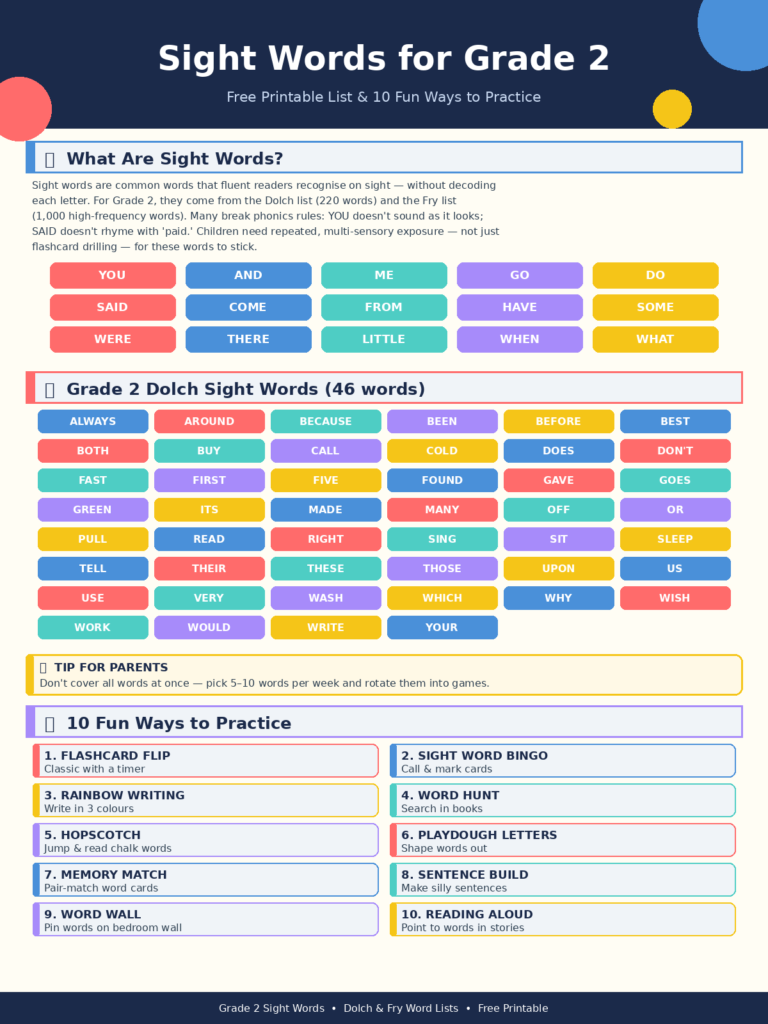
Grade 2 Dolch Sight Words (alphabetical)
always, around, because, been, before, best, both, buy, call, cold, does, don’t, fast, first, five, found, gave, goes, green, its, made, many, off, or, pull, read, right, sing, sit, sleep, tell, their, these, those, upon, us, use, very, wash, which, why, wish, work, would, write, your
Additional Fry Words commonly tested in Grade 2
about, after, again, also, an, another, came, could, even, every, far, form, give, good, great, hand, help, here, high, him, house, how, just, kind, know, large, last, leave, let, like, line, long, look, man, may, most, move, much, must, new, next, night, old, only, open, other, out, own, part, place, play, put, run, same, saw, say, see, small, start, still, stop, take, than, then, think, three, time, too, try, turn, two, under, want, water, way, well, went, were, where, while, who, will, with, without, word, year
Tip for parents: Do not try to cover all of these at once.
Pick 5 to 10 words per week and rotate them into the games below.
10 Fun Ways to Practice Sight Words at Home
The biggest shift in our household came when I stopped making my daughter sit at a desk.
Second graders have endless physical energy.
When learning happens through movement, touch, and play, the brain encodes words far more effectively than it does through repetition alone.
These 10 hands-on activities are tested, practical, and genuinely enjoyable.
1. Sight Word Swat (Best for High-Energy Kids)
Why it works: Physical movement creates muscle memory.
When a child runs to find a word and then uses it in a sentence, the word gets stored in multiple parts of the brain at once.
How to play:
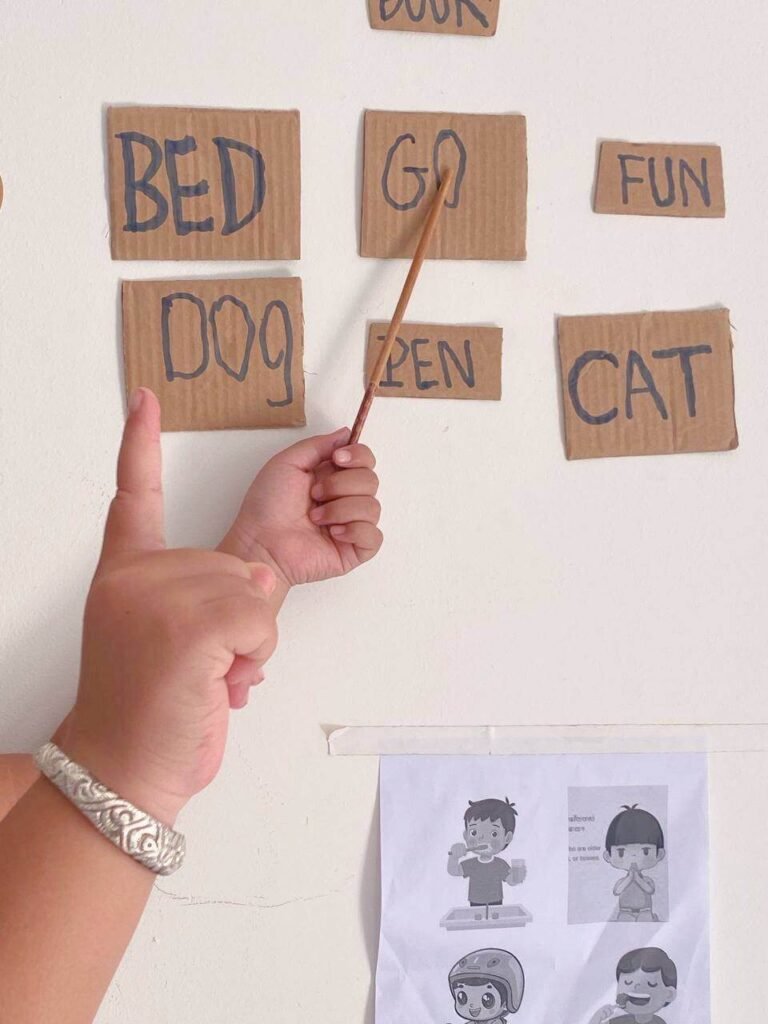
- Cut milk cartons or cereal boxes into small squares and write one sight word on each.
- Let your child write a few words they already know (GO, DOG, CAT) to build confidence.
- Tape all the cards to the wall around the room.
- Hand your child a chopstick or rolled newspaper as a “pointer.”
- Call out a word. They must run, find it, and swat it as fast as possible.
- For an extra challenge, ask them to use the word in a sentence after they hit it.
Parent tip: Keep the energy playful and competitive.
Time them with a stopwatch and let them try to beat their own record.
2. Invisible Ink Reveal (Best for Creative Kids)
Why it works: Turning reading practice into a magic trick creates genuine excitement.
Children who dread worksheets will happily hunt for secret words.
How to play:
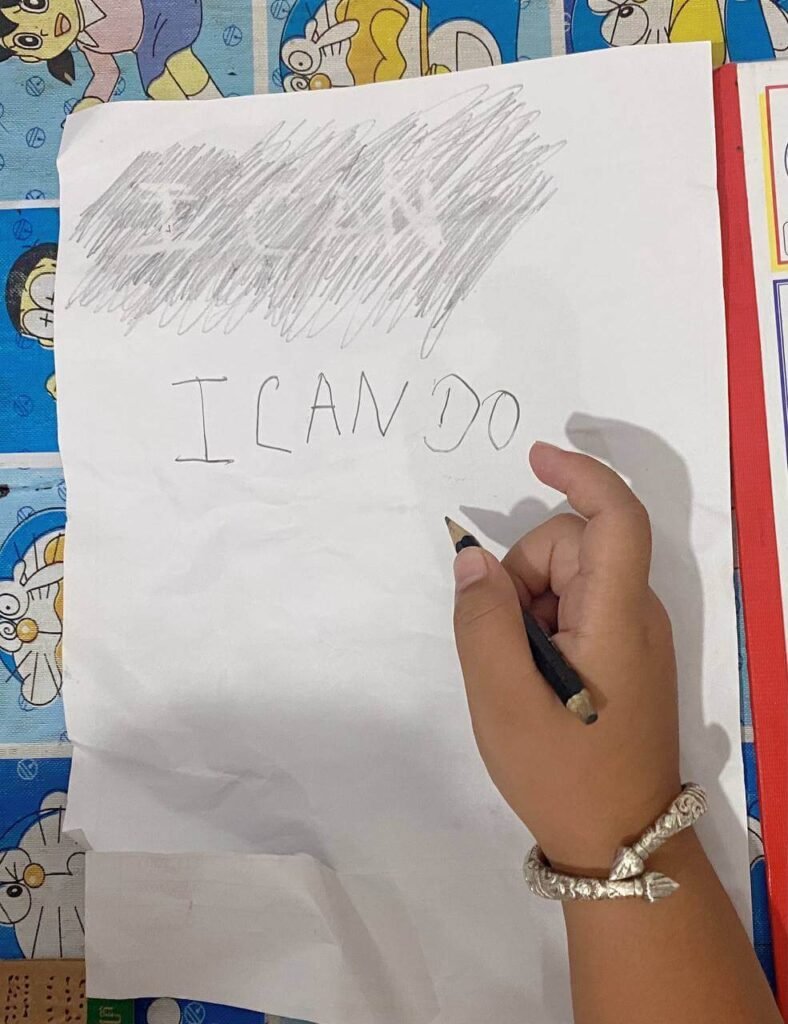
- Use a white crayon or a yellow crayon to write a sight word on white paper.
- Your child uses watercolour paint or a dark pencil to shade over the paper.
- The word magically appears.
- Once they find the word, ask them to add their own word to finish a thought. For example, after finding “I CAN,” they might add “I CAN FLY.”
3. Sight Word Hopscotch (Best for Kids Who Cannot Sit Still)
Why it works: This is kinesthetic learning at its most straightforward.
Children who struggle to focus at a desk often thrive when their whole body is involved.
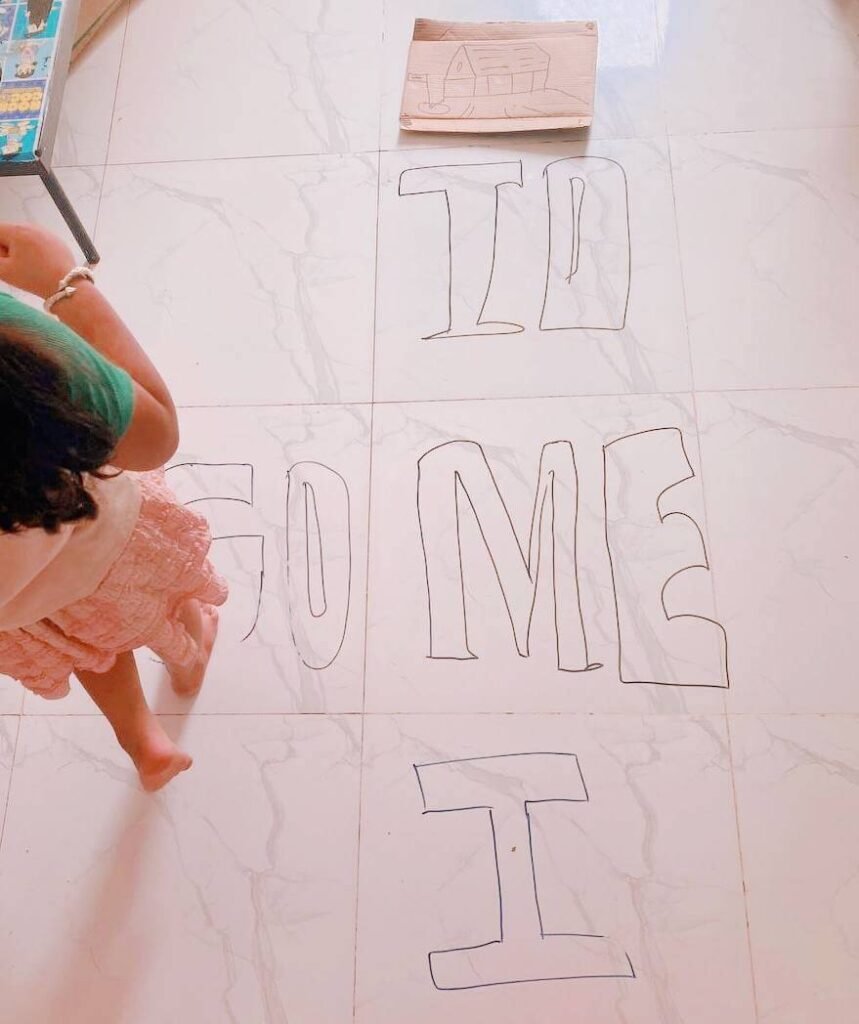
How to play:
- Draw a hopscotch grid on the floor (tape works on carpet; chalk works outside).
- Instead of numbers, write sight words in each square: I, GO, ME, SEE, THE, WE.
- Your child must read each word out loud before jumping on it.
- Set a “destination” at the end, such as a cardboard box labelled “School” or “Home.”
4. Flashlight Word Hunt (Best for Focus and Attention)
Why it works: Changing the environment changes the mood.
Dimming the lights and handing a child a flashlight transforms reading practice into an adventure.
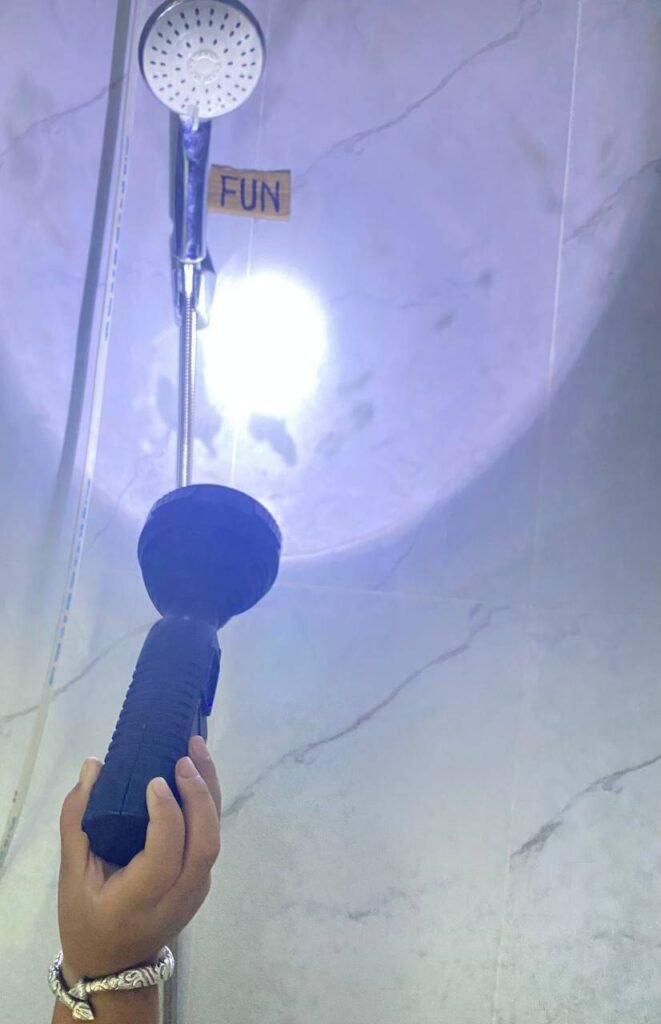
How to play:
- Write sight words on index cards or sticky notes and hide them around the house, including in unusual spots like the bathroom or under a cushion.
- Tell your child they are a “Word Detective” on a mission.
- Every time the flashlight beam hits a word, they must shout it out and collect the card.
- At the end, count up the words together and read them aloud.
5. Sensory Rice Writing (Best for Tactile Learners)
Why it works: This is a classic multisensory sight word practice technique.
When children trace letters with their fingertips, the physical sensation reinforces spelling in a way that pen and paper cannot.
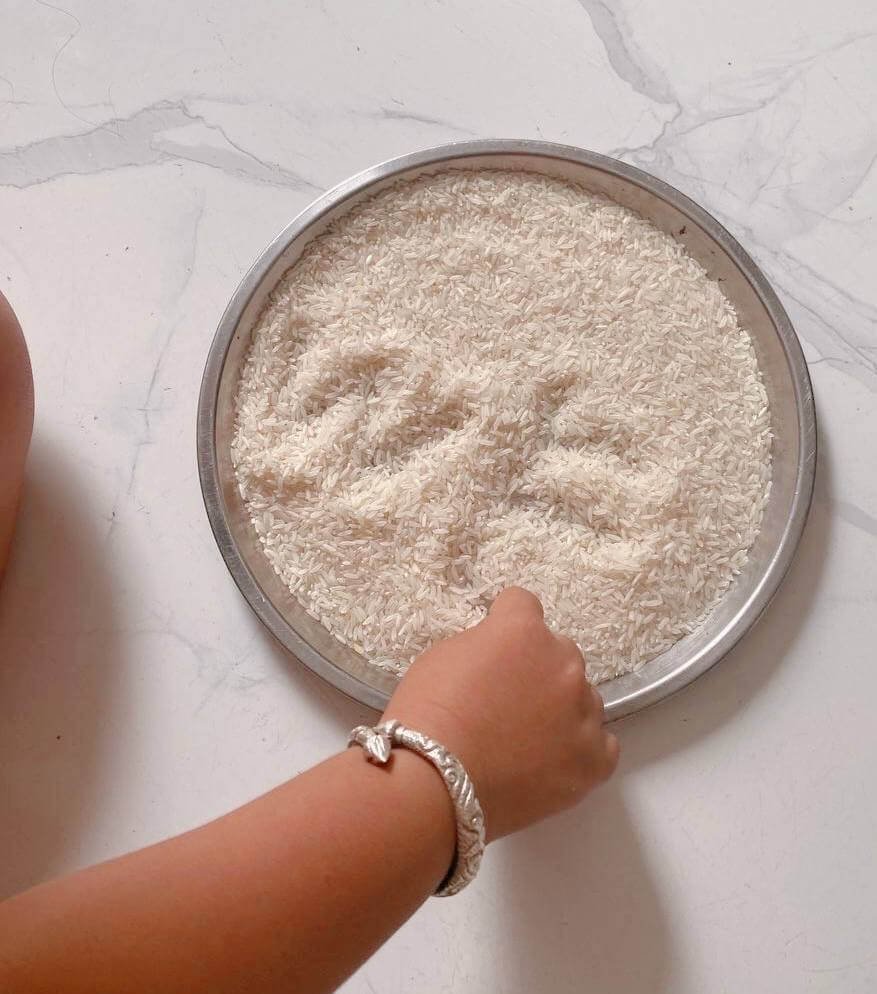
How to play:
- Pour a thin layer of uncooked rice onto a baking tray or shallow dish.
- Call out a sight word (for example, WE or COME).
- Your child traces the letters in the rice with one finger.
- If they make a mistake, they simply shake the tray to “erase” and start again.
Variation: Try this with sand, salt, or even shaving foam for different sensory experiences.
6. Sight Word Parking Lot (Best for Kids Who Love Toy Cars)
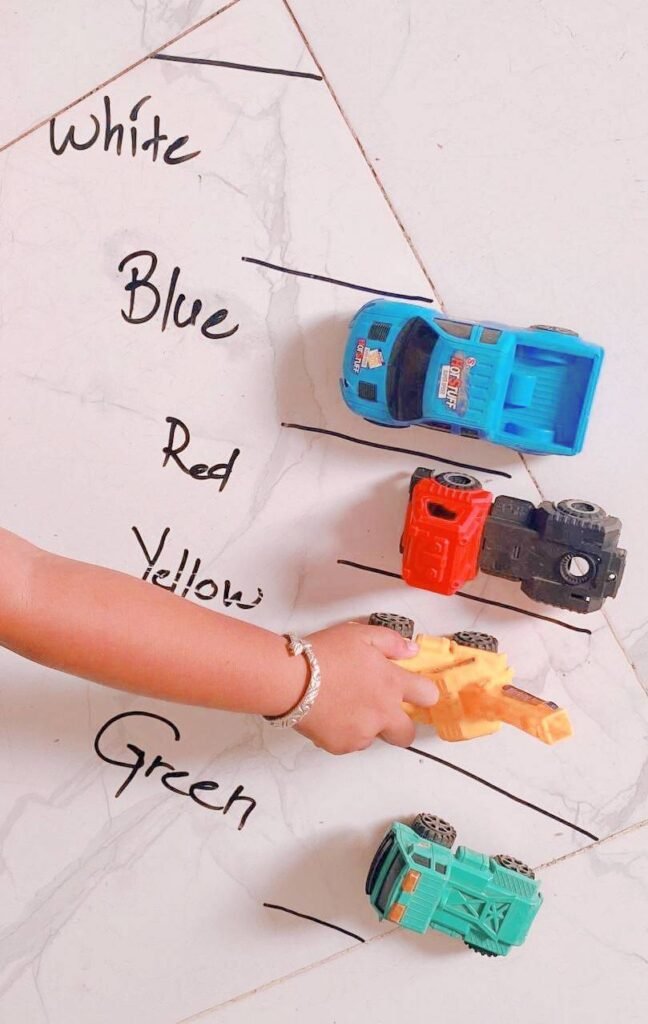
How to play:
- Draw a large parking lot on a sheet of paper or cardboard, with a sight word written in each parking space.
- Your child uses small toy cars to “drive” to the correct space based on the word or colour you call out.
- Example instruction: “Park the red car in the COME space.”
- For a challenge, give two-step instructions: “Drive past HAVE and park next to THERE.”
7. Building Blocks of Letters (Best for Spelling Practice)
How to play:
- Cut small squares of paper and write one letter on each square. Prepare a mix of common letters.
- Call out a sight word (for example, HAND or FROM).
- Your child searches through the letter squares to build the word.
- Once built, they read it aloud and use it in a sentence.
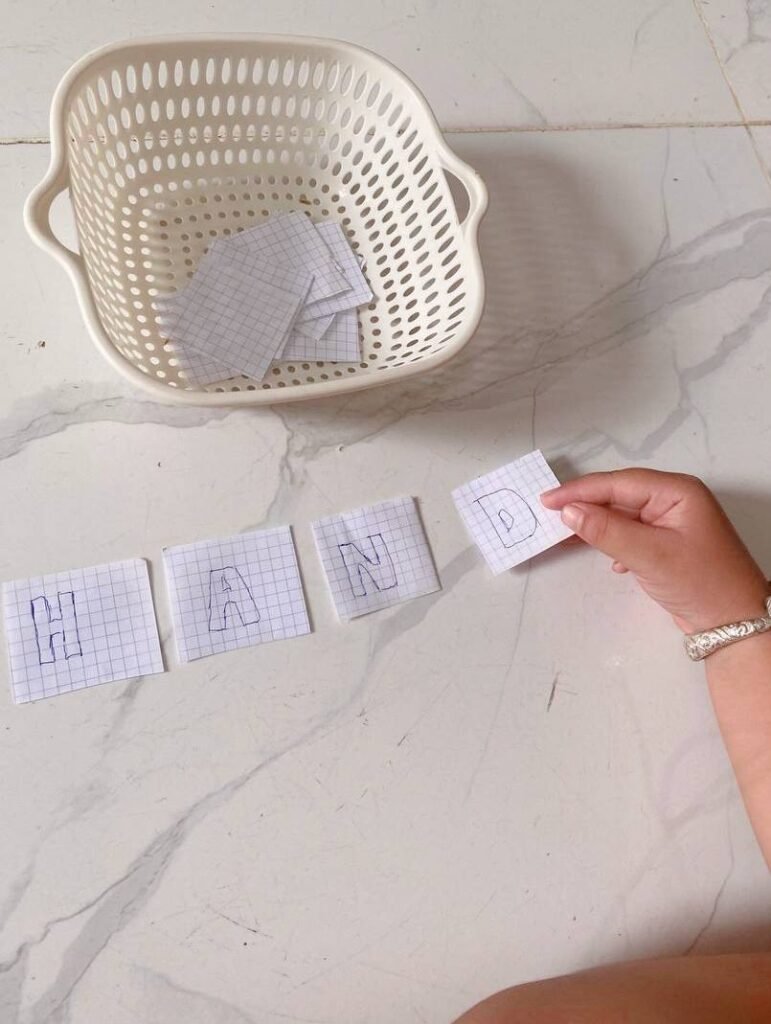
Parent tip: Keep the letter pool small (8 to 15 letters at a time) so the task feels achievable rather than overwhelming.
8. Sight Word Bingo (Best for Family Play)
Why it works: Bingo introduces friendly competition and repeated word exposure without feeling like a lesson.
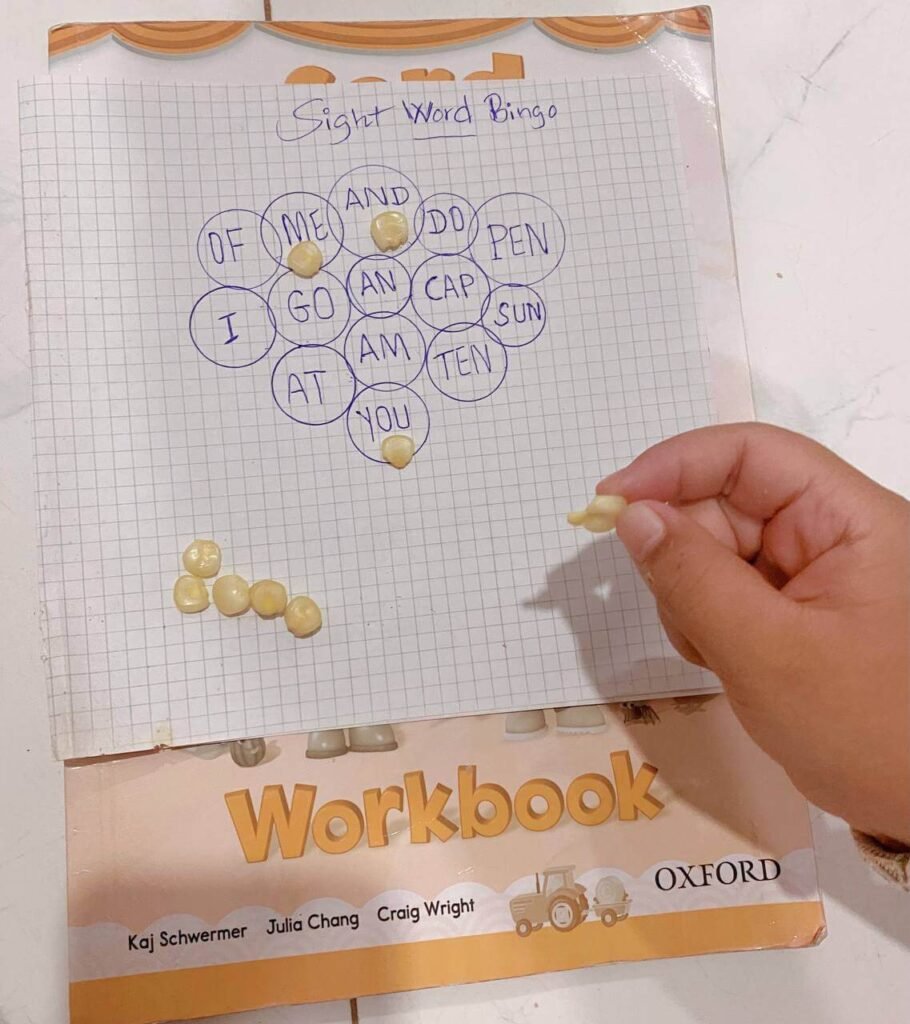
How to play:
- Instead of a traditional grid, draw a “word chain” on paper: circles connected in a line, each containing a sight word.
- Read words aloud one at a time. Your child covers each word they hear with a corn kernel or small coin.
- When they complete a full line, they win. But the prize requires reading every word in that line aloud as a sentence, for example: “YOU AND ME.”
9. The Recording Star (Best for Kids Who Love Performing)
How to play:
- Turn sight words into a short chant or song based on your child’s favourite tune.
- Record them on your phone as they sing or chant the words.
- Play it back immediately so they can hear themselves.
Why it works: Hearing their own voice creates an instant sense of pride and ownership.
This also builds reading fluency and pronunciation confidence, particularly useful if English is your child’s second language.
10. The Book Scavenger Hunt (Best for Connecting to Real Reading)
Why it works: Many children learn sight words in isolation and never connect them to actual books. This game closes that gap.
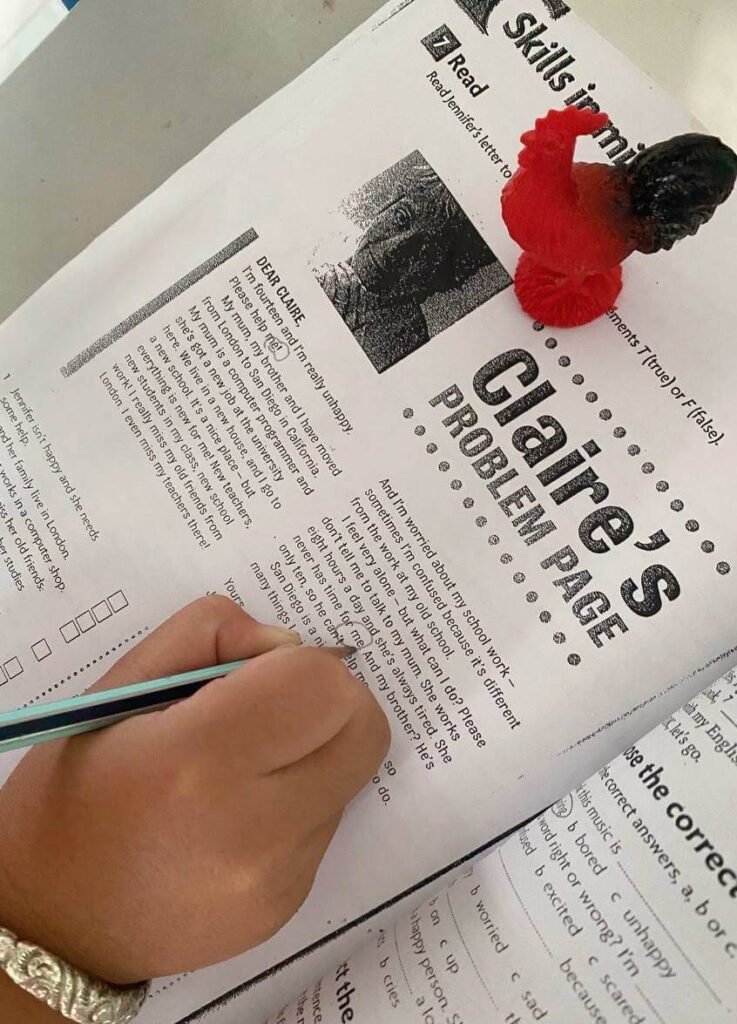
How to play:
- Open any English storybook to a page with a comfortable amount of text.
- Give your child one “target” word (for example, ME or COME).
- Every time they find that word on the page, they circle it with a pencil.
- Count up the total at the end and celebrate.
Why this matters: When children see that the words they practise at home appear in real stories, they begin to trust that learning is worthwhile.
Tips for Teaching Sight Words to a Struggling Reader
If your child regularly cries or shuts down during reading practice, you are not alone, and it is not your fault.
Here are a few adjustments that made the biggest difference for us.
- Start with words they already know. Before introducing new words, build a small “I Can Read These” pile of mastered words. Beginning with success sets a positive tone for the whole session.
- Keep sessions short. Ten focused minutes of playful practice are more effective than 45 minutes of frustrated drilling. When your child starts losing interest, stop. Always end on a win.
- Separate learning from performance. Avoid testing your child immediately after introducing a new word. Give them time to absorb it through games before asking them to recall it under pressure.
- Celebrate the process, not just accuracy. My daughter still gets words wrong sometimes. But we traded daily tears for daily smiles, and that shift happened because I stopped treating every mistake as a problem to fix and started treating it as part of the process.
- Try kinesthetic alternatives first. If a worksheet is not working, replace it with one of the movement-based games above before assuming the child has a learning difficulty. Many second graders simply need to move.
Reading Milestones: What to Expect by the End of the Year
By the end of Grade 2, most children who practise regularly should be able to recognise the full set of Dolch Grade 2 words (46 words) on sight with no hesitation.
Combined with Grade 1 and Kindergarten Dolch words, that gives them a foundation of roughly 150 to 200 high-frequency words, which covers a large percentage of the words they will encounter in everyday reading.
Progress is not always linear.
Some weeks, your child will sprint ahead.
Other weeks, they will seem to forget words they knew perfectly last month.
Both are completely normal.
Learning a second language is a marathon, not a sprint.
The Bottom Line
Mastering sight words for Grade 2 does not require expensive apps, tutors, or hours at a desk.
It requires creativity, consistency, and the willingness to step away from the worksheet.
The 10 games in this guide work because they meet second graders where they naturally are: moving, exploring, and looking for ways to feel capable.
Pick two or three that fit your child’s personality, rotate them through the week, and let the printable list on the fridge serve as a quiet reminder of how far they are coming.
Your child does not need to be perfect.
They need to feel like reading is something they can do.
That belief, built one small win at a time, is what makes everything else possible.
Frequently Asked Questions
What are the Grade 2 Dolch sight words?
The Grade 2 Dolch list contains 46 high-frequency words, including common terms like always, because, sleep, and write. You can find the complete alphabetical list in the printable reference section above!
How many sight words should a second grader know?
Most Grade 2 reading benchmarks expect children to recognise between 100 and 200 sight words by the end of the school year. This includes Kindergarten and Grade 1 Dolch words carried forward, plus the 46 new Grade 2 words. Fry word programmes may set a higher target of around 300 words.
What is the best way to practise sight words at home?
The most effective approach for second graders is multisensory, movement-based practice rather than flashcard drilling. Activities like rice writing, sight word hopscotch, and the flashlight word hunt engage multiple senses at once, which helps the brain store words more reliably. Short daily sessions (10 to 15 minutes) work better than long infrequent ones.
How do I help a child who struggles with sight words?
Start with words your child already knows to build confidence. Keep practice sessions short and playful. Use physical games instead of worksheets whenever possible. Avoid pressuring your child to perform immediately after learning a new word. If struggles persist over several months, speak with your child’s teacher about whether additional reading support might help.
Are Dolch words and Fry words the same thing?
No, but they overlap significantly. The Dolch list contains 220 words organised by grade level (Pre-K through Grade 3, plus nouns). The Fry list contains 1,000 words ranked purely by frequency in printed text, with no grade groupings. Most schools use one or the other; both are widely accepted as effective frameworks for teaching sight word recognition.
At what age should children know sight words?
Most sight word instruction begins in Kindergarten (around age 5 to 6) with the simplest words (I, A, THE, AND). By Grade 2 (age 7 to 8), children are expected to recognise a larger set of more complex high-frequency words automatically. Every child develops at a different pace, so use grade-level benchmarks as a guide, not a strict standard.
Can these activities work for ESL or bilingual children?
Yes. Several of the games above, particularly the recording activity and the book scavenger hunt, are especially helpful for children learning English as an additional language. Hearing themselves read, and seeing words in context within real books, builds both vocabulary and pronunciation confidence in ways that isolated flashcard practice rarely does.
