

Disclaimer: The content on Sprout Upward is designed to encourage intentional family leadership. I am a mom of two and a former youth worker sharing my real-life experiences, not a licensed therapist or medical professional. These guides adapt my professional team management background to daily home life. Please consult your pediatrician for any clinical, medical, or psychological advice regarding your child.
Three months ago, I was convinced I was being a good parent.
Every evening, the moment our three-year-old son started disrupting his older sister’s homework session, I would scoop him up and take him to the other room.
I thought I was keeping the peace.
What I did not realize was that I was quietly interrupting something far more important: toddler learning by observation, one of the most natural and powerful ways young children absorb the world around them.
This is the story of what changed when we stopped separating him, and what happened over the next two months.
Key Takeaways
Before we get into the full story, here is a quick summary of what you will find in this article:
- Toddlers learn by watching the people they love most, especially older siblings, during everyday routines.
- Separating your toddler from homework time may interrupt their natural curiosity about books and learning.
- You do not need educational toys or special programs. A consistent home learning environment with older siblings present is often enough.
- The “grabbing phase” is not bad behavior. It is a sign of genuine interest.
- With consistent daily exposure, a toddler can shift from disrupting study time to sitting quietly and reading within 2 to 3 months.
- Observational learning in young children is backed by decades of research in early childhood development.
Why My Three-Year-Old Could Not Stay Away from Homework Time
Every evening after dinner, we took a 30-minute break before settling into our study routine at 8:00 PM.
My husband would pull out the small whiteboard and guide our eight-year-old daughter through her school exercises.
It was calm, focused, and productive.
Until our son arrived.
He would sneak over and grab her erasers.
Then her pencils. Then her notebooks.
On one particular evening, he spotted her watch sitting on the table and threw it across the room.
I was constantly pulling him away, telling him to stop, and redirecting him toward his toys.
I thought separating him was the solution.
My husband sat there, teaching our daughter with one hand while using the other to keep our son from grabbing the books.
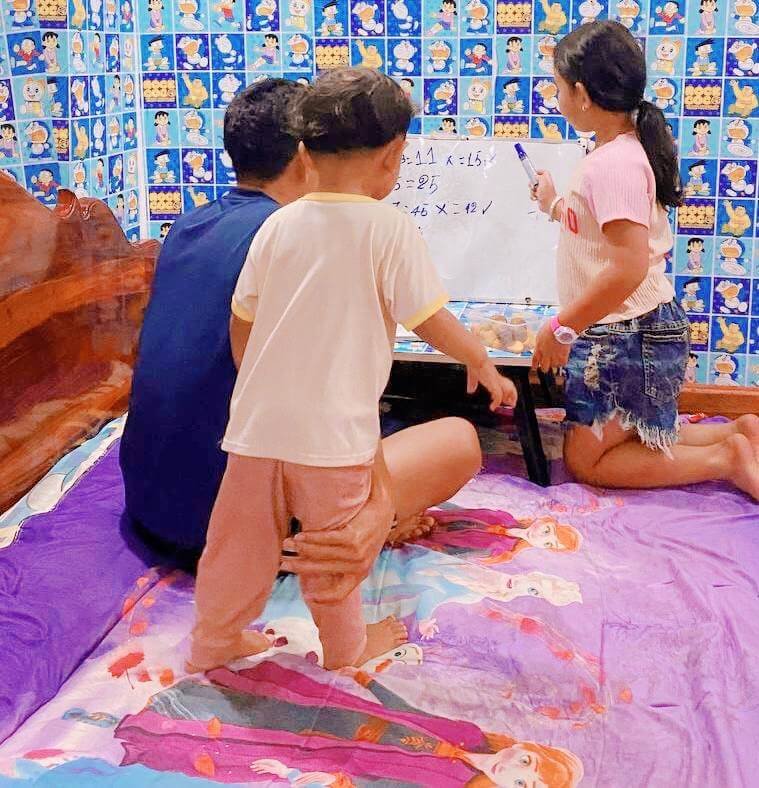
Out of pity for both of them, I would say the same thing every single night: “Come on, son, let us go upstairs.”
And every single night, my husband said no.
At the time, that frustrated me.
Now, I understand that he was seeing something I kept missing.
The Clock Moment That Changed Everything
One evening, my husband set a five-minute timer using the clock on the table.
Our daughter had an exercise to complete, and the clock was placed right beside her.
The second it hit the table, our son made a beeline for it.
I called him away, as usual.
My husband stopped me.
He let our son hold the clock.
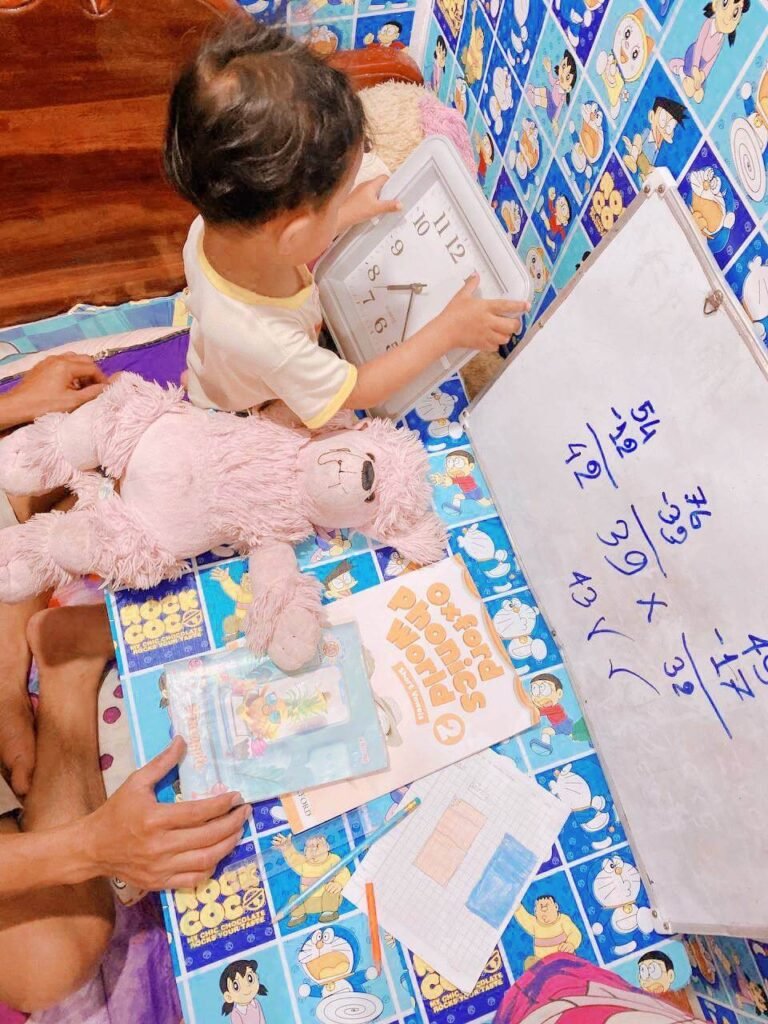
He let him sit there in the middle of everything.
Instead of the disruption I expected, something quieter happened.
Our son sat and watched.
He did not throw the clock.
He did not run off.
He just sat there, looking at his sister writing on the whiteboard, like it was the most interesting thing he had ever seen.
That evening was the first time I thought: maybe he is not trying to ruin homework time.
Maybe he is trying to join it.
Why Toddlers Learn by Watching Older Siblings (And Why It Matters)
Here is what my husband understood before I did.
Toddlers are wired for imitation.
When our son saw the people he loved most gathering every evening around a whiteboard with books, pencils, and a clock, he was not causing chaos out of boredom.
He was drawn to the activity because it looked meaningful.
This is exactly how toddler learning by observation works.
Research in early childhood development describes this process as one of the primary ways young children build habits, behaviors, and early literacy skills.
The psychologist Albert Bandura, who spent decades studying how children learn, found that children do not need formal instruction to absorb new behaviors.
They need consistent, positive exposure to those behaviors in action.
When a toddler watches an older sibling sit down, open a book, and focus, their brain catalogs that behavior.
It links it to warmth, familiarity, and the normal rhythm of family life.
Over time, the toddler does not just observe the behavior. They begin to mirror it.
Sibling influence on early childhood development is often underestimated by parents.
An older brother or sister doing homework is, in a toddler’s eyes, one of the most compelling role models in the world.
What We Did Differently: Creating a Home Learning Environment for Toddlers
After the clock moment, we stopped sending our son away.
Instead, we built a small space for him right alongside the family study session.
We set up a low table with three small chairs, a separate little whiteboard, and a handful of basic supplies.
Nothing fancy.
There was no curriculum, no lesson plan, no expectation.
We simply gave him a seat at the table and let him be part of the routine.
The first few weeks were still messy.
He still grabbed things sometimes.
He still wandered off.
But we kept the space there and the routine consistent.
The Transformation: What Two Months of Observational Learning Looked Like
Somewhere around the two-month mark, the change became impossible to ignore.
Our son started sitting at his little table and looking at his sister’s math textbook with the kind of focus I had only ever seen in older children.
He set up his stuffed animals beside him, as if they were classmates.
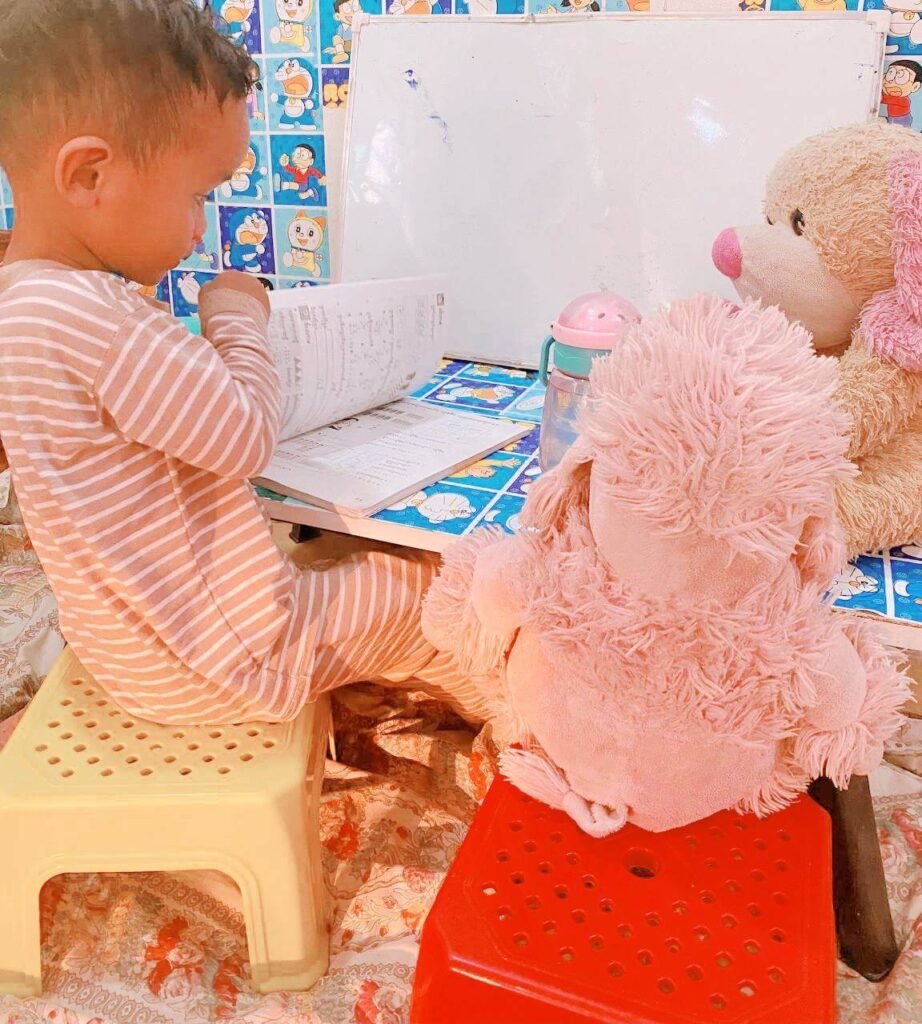
He was not playing.
He was doing exactly what he had watched us do every evening for weeks.
On weekends, when our daughter practiced English as a second language, our son would slide over and sit right next to her.
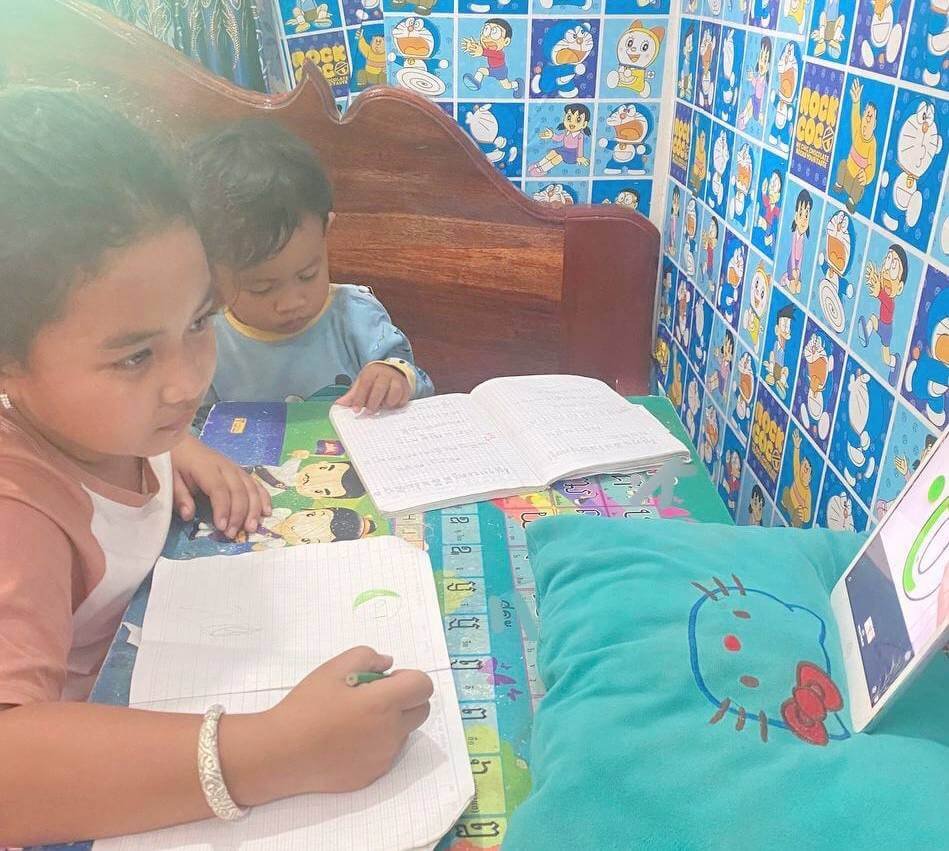
Silent. Attentive. Acting as if he were following along with every word.
When she left for school during the week, he sometimes found her books on his own, sat down on the bed, and flipped through the pages one by one.
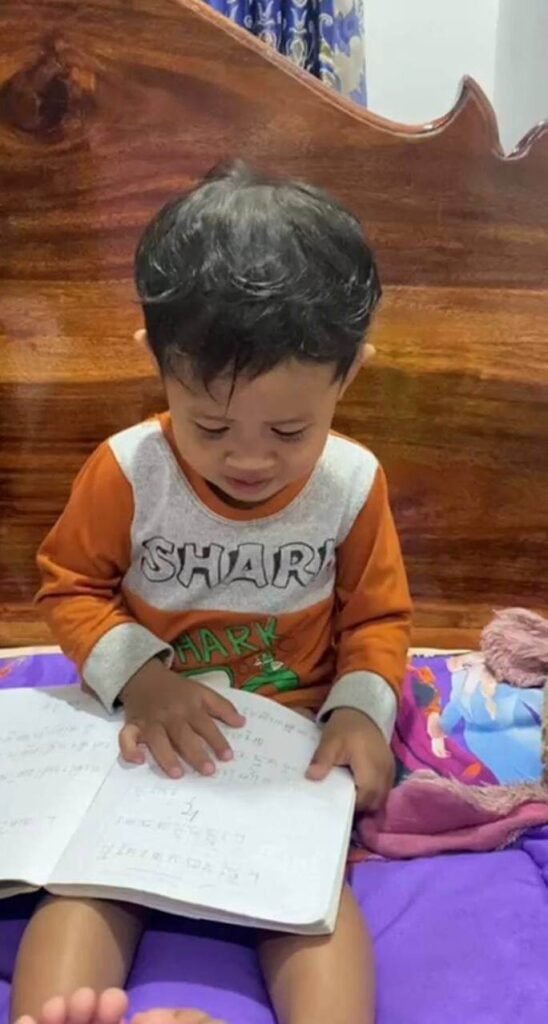
The child who used to throw things across the room was now the one who did not want to leave the study space.
What This Taught Me About Encouraging a Love of Learning in Toddlers
Looking back, the shift was not magic.
It was the environment.
Our son was learning the whole time.
We just kept removing him from the place where the learning was happening.
Here is what worked for our family, based on two months of watching this unfold:
- Keep learning visible in shared spaces. Do not tuck older children away in bedrooms for homework. When study time happens in a shared room, toddlers get daily exposure to what focused learning looks like.
- Give your toddler a seat and their own materials. A small stool, a notebook, and a crayon are enough. The point is not what they do with those materials. The point is that they have a place where they belong during study time.
- Let the grabbing phase run its course. When a toddler reaches for pencils and books, they are curious, not naughty. Gentle redirection works far better than removal. Give them something of their own to hold, and let them stay.
- Stay consistent over weeks, not days. Toddler learning by observation does not produce results overnight. Two months of steady, nightly exposure was what it took for our son. Patience is the strategy here.
- Trust the environment to do the teaching. You do not need special learning apps, flashcard systems, or structured toddler programs. A home where older children read and study regularly is one of the best early learning environments a toddler can grow up in.
Final Thought
If my husband had agreed to let me take our son upstairs every single evening, I genuinely do not think our son would be the child who now sits quietly with books.
The curiosity was always there. We just needed to stop interrupting it.
The most meaningful thing you can do to support your three-year-old’s learning habits may not involve any teaching at all.
It might simply be letting them stay in the room, giving them a seat at the table, and trusting that toddler learning by observation will do the rest.
Common Questions About Managing Toddlers During Homework
Should I let my toddler sit with older children during homework time?
In most cases, yes. Toddlers develop early habits and emotional associations through watching the people they trust. When your toddler sees an older sibling sitting down, focusing, and working with books, their brain begins treating that behavior as normal and desirable.
You do not need to formally involve them. Simply letting them be present in the same space, with their own small materials nearby, is a great starting point.
Why does my toddler grab everything during study time?
Grabbing is how toddlers express interest. When your child reaches for pencils, erasers, or a timer, they are drawn to the same objects the people they love are using.
It is a sign of curiosity, not defiance. Rather than removing your toddler from the room, try giving them their own notebook or crayons so they have something to engage with nearby.
Can a 3-year-old really start to develop a love of studying?
Not in a formal academic way, but absolutely yes. A three-year-old can develop a genuine comfort with books, a familiarity with sitting through a learning routine, and a positive emotional connection to study time.
Those early associations are exactly what build school readiness and a love of learning later on.
How long does toddler observational learning take to show results?
Based on our experience, consistent daily exposure for about two months was enough to produce a visible change in our son’s behavior. Every child develops at their own pace, but early childhood researchers consistently point to consistency over time as the most important factor, not the intensity of any single session.
What if my toddler is still too disruptive during homework time?
Start with smaller windows of shared time. Even ten to fifteen minutes with your toddler present, alongside their own simple materials, can begin building the association between your family and learning.
You can gradually extend the time as they grow more settled. Keeping the routine daily matters more than the length of each session.
Does the home learning environment really influence how toddlers develop early literacy?
Research in early childhood development strongly supports this. Children who grow up in homes where books, study materials, and focused learning are part of the daily routine tend to develop earlier and stronger literacy habits.
The environment shapes a child’s behavior in ways that are often invisible until you look back months later and realize something quietly changed.
