

Disclaimer: The content on Sprout Upward is designed to encourage intentional family leadership. I am a mom of two and a former youth worker sharing my real-life experiences, not a licensed therapist or medical professional. These guides adapt my professional team management background to daily home life. Please consult your pediatrician for any clinical, medical, or psychological advice regarding your child.
When my daughter first started Kindergarten 1 (often called Pre-K in the US), I tried to help her practice reading by making up long, complicated sentences about random things around the house.
Nothing was specific. Nothing was focused.
Every time she sat down to read, she looked unhappy, and within minutes, she would forget the words she had just read.
I found myself asking the same questions every day. “Did you practice reading today?” “Do you remember this sentence?” “Can you read this for me?”
It took me a while to realize the problem wasn’t her.
She wasn’t careless, and she wasn’t incapable of remembering. The problem was my approach.
It was scattered, with no system behind it.
This article walks through the method I eventually landed on for building simple sight word sentences for kindergarten, one that grew directly out of my daughter’s real classroom experience and actually got her reading on her own.
Key Takeaways
- Random sentences about unrelated objects make reading harder for beginners. Sentences built from your child’s actual textbook are easier to recognize and remember.
- Combining sight words with CVC words (simple, sound-out words like “sun,” “big,” or “red”) gives kids a sentence they can both memorize and decode.
- Three sentence types work well for early readers: “I see” phrases, action phrases, and descriptive phrases.
- Four low-prep worksheet formats turn these sentences into real practice: Read-Trace-Draw, fill in the blank, cut and paste, and a sight word hunt.
- This method works whether your child is in Pre-K (K1) or Kindergarten (K2). The sentences just get a little longer as your child progresses.
- The real goal isn’t memorizing words in isolation. It’s helping your child read sentences automatically, without you having to prompt them every time.
Why Random Sentences Don’t Work for Beginning Readers
When my daughter was in Kindergarten 1, I used to make up sentences about whatever was nearby.
The fridge, the TV, and a chair. None of it connected to anything she was already learning, so every sentence felt brand new to her.
For a child who is just starting to recognize words, that kind of randomness is more confusing than helpful.
If your child reads a sight word sentence just fine one day and seems to forget it the next, this is usually why. The words have no anchor.
There’s nothing tying them back to something familiar, so the brain has to work from scratch every single time.
How to Teach Sight Words Using Your Child’s Kindergarten Textbook
The method that actually worked was much simpler than what I had been doing.
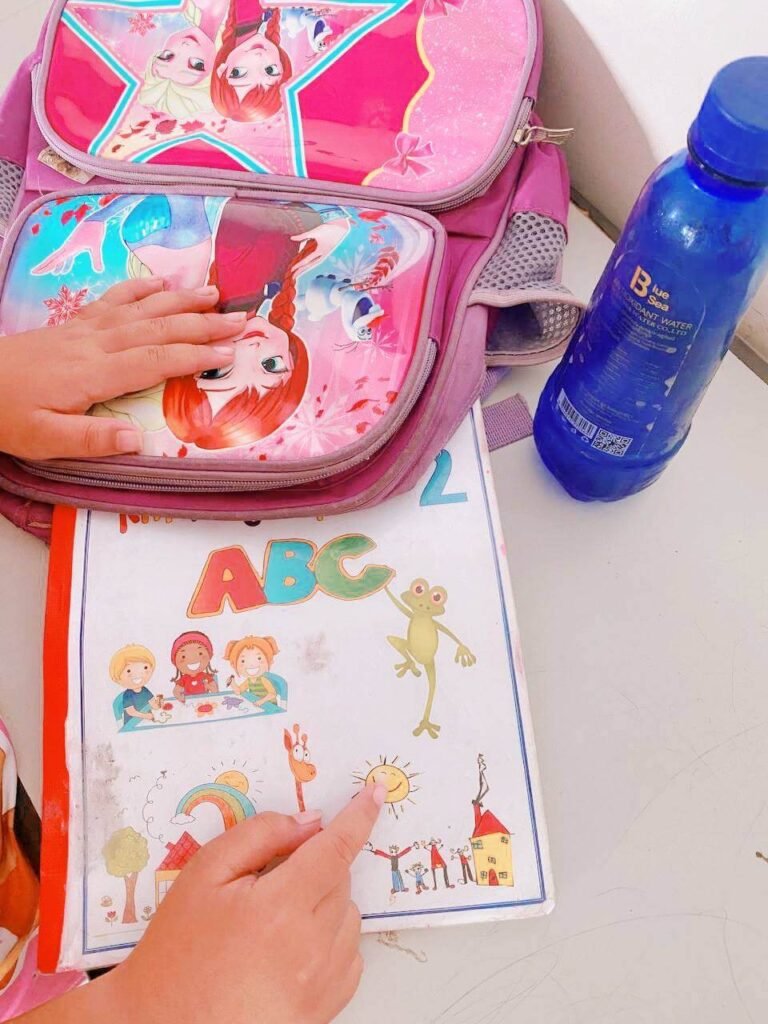
Instead of inventing random sentences, I started building them directly from the textbook she was already using in class.
A quick note before we go further: in this article, I used a Kindergarten 2 book as the template, but the same approach works just as well for Kindergarten 1.
You’re simply matching the difficulty of the sentence to whatever book your child already has in their bag.
I combined commonly used sight words with easy-to-sound-out CVC words I found right on the covers and pages of her books.
That’s really the whole method. Sight words plus CVC words plus sentences your child already half-recognizes from class equals sentences that feel familiar instead of foreign.
Simple Sentences With Sight Words and CVC Words
Once I started pulling vocabulary straight from her textbook, I sorted the sentences into three simple categories.
You can use this same structure with almost any sight word and CVC word list.
“I See” Sentences for Kindergarten
- I see a green frog.
- I see the big sun.
- I see a red house.
- I see the funny snowman.
- I see a big star.
Action Phrases
- The frog can jump up.
- The kids can sit.
- We can go to the house.
- The snowman can run!
- They can play here.
Descriptive Phrases
- The sun is yellow.
- It is a big tree.
- The bag is pink.
- He is very tall.
- It is a little house.
These three formats cover most of what a kindergartner needs at this stage: naming what they see, describing simple actions, and describing how something looks.
They’re also short enough that a beginning reader doesn’t lose steam halfway through the sentence.
4 Free Sight Word Worksheet Ideas You Can Make at Home
After I had a bank of sentences, the next step was turning them into something my daughter could actually practice with.
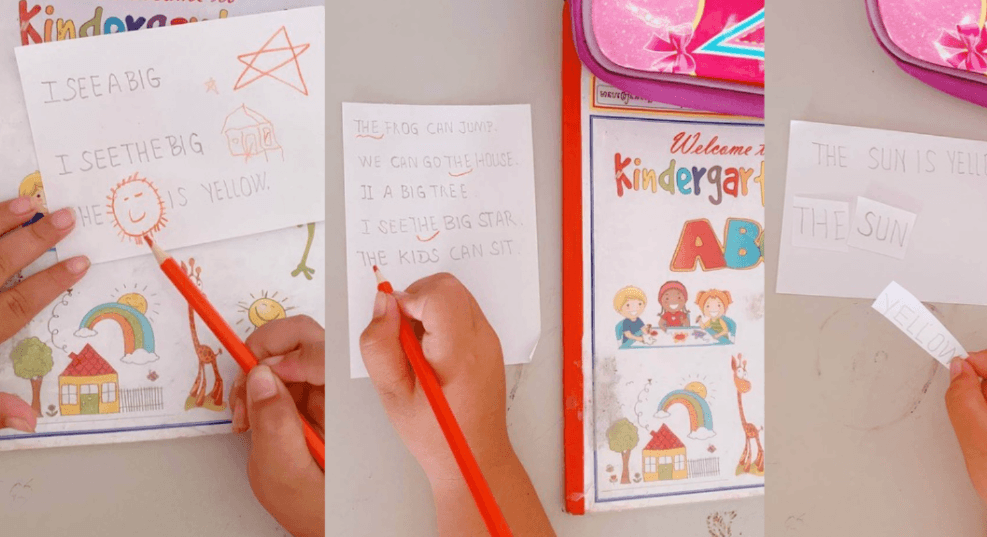
You don’t need anything fancy here. I wrote most of these by hand, though you could just as easily copy them into Microsoft Word if you’d rather print them.
1. Read, Trace, and Draw
Goal: Practice reading, handwriting, and comprehension all in one go.
How to do it: Write a sentence, such as “I see the big sun,” in a dotted font so your child can trace it. Leave a large blank box underneath for them to draw what the sentence says.
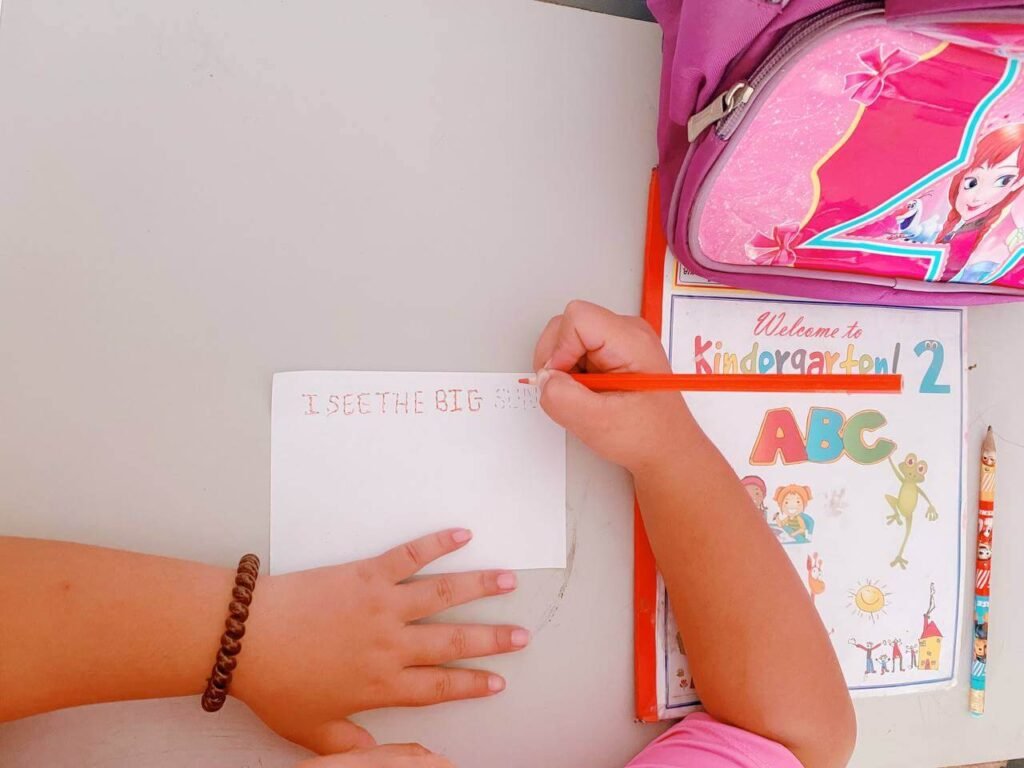
This step matters more than it seems. Drawing the meaning is what tells you whether your child actually understood the sentence, not just decoded it.
2. Fill in the Blank With Picture Clues
Goal: Build confidence by giving your child a visual safety net.
How to do it: Add a small word bank at the top, something like [ can ] [ see ] [ my ].
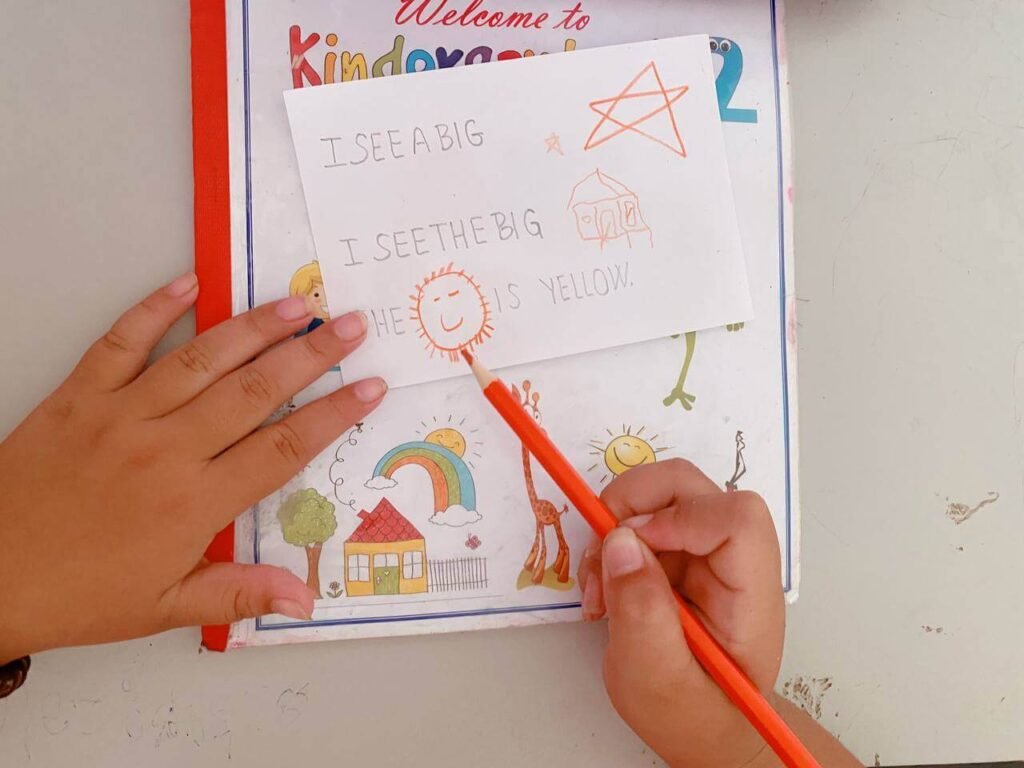
Then write the sentences with a blank space, and draw a small picture next to each one as a hint.
I _______ the big sun. (draw a sun nearby)
I _______ a red house. (draw a house nearby)
I _______ a big star. (draw a star nearby)
3. Cut and Paste Sentence Building
Goal: Teach sentence structure, including capital letters at the start and punctuation at the end.
How to do it: Write the full sentence at the top as a reference, for example, “The sun is yellow.” Below it, place cut-out word strips like [ yellow. ] [ The ] [ is ] [ sun ], scrambled out of order.
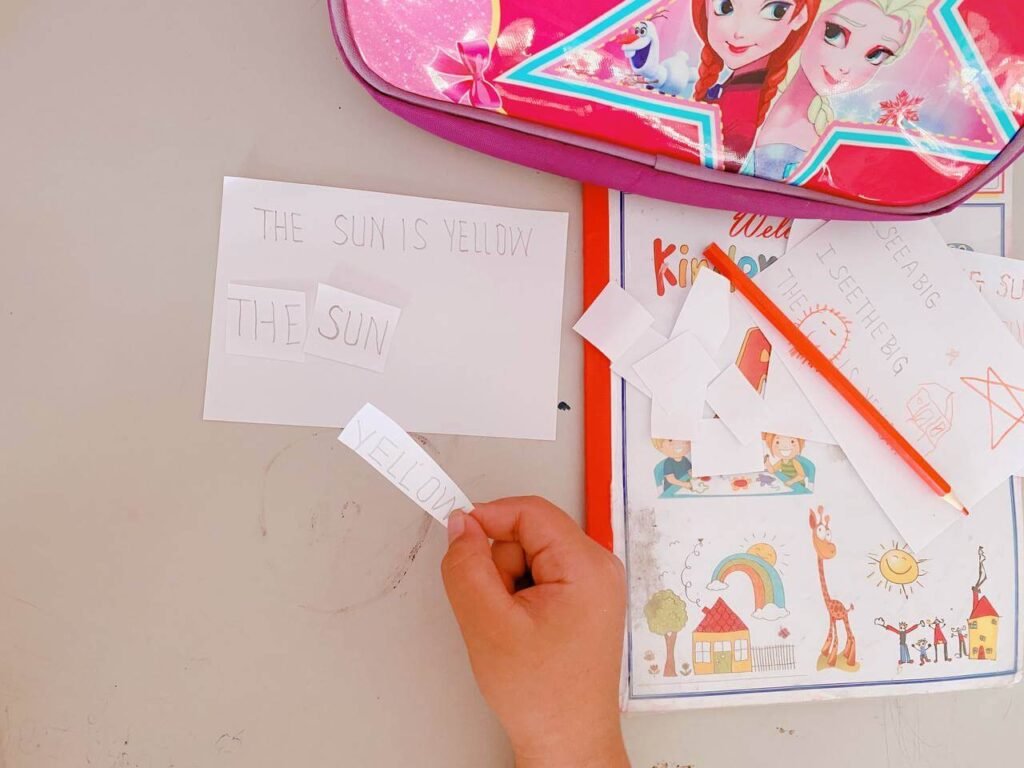
Your child cuts them out and pastes them back in the correct order. It’s a small task, but it does a lot of work for understanding how a sentence is actually built.
4. Sight Word Hunt With a Colored Pencil or Highlighter
Goal: Train your child’s eyes to spot common words quickly, without sounding them out every time.
How to do it: Pick one target word, for example, THE.
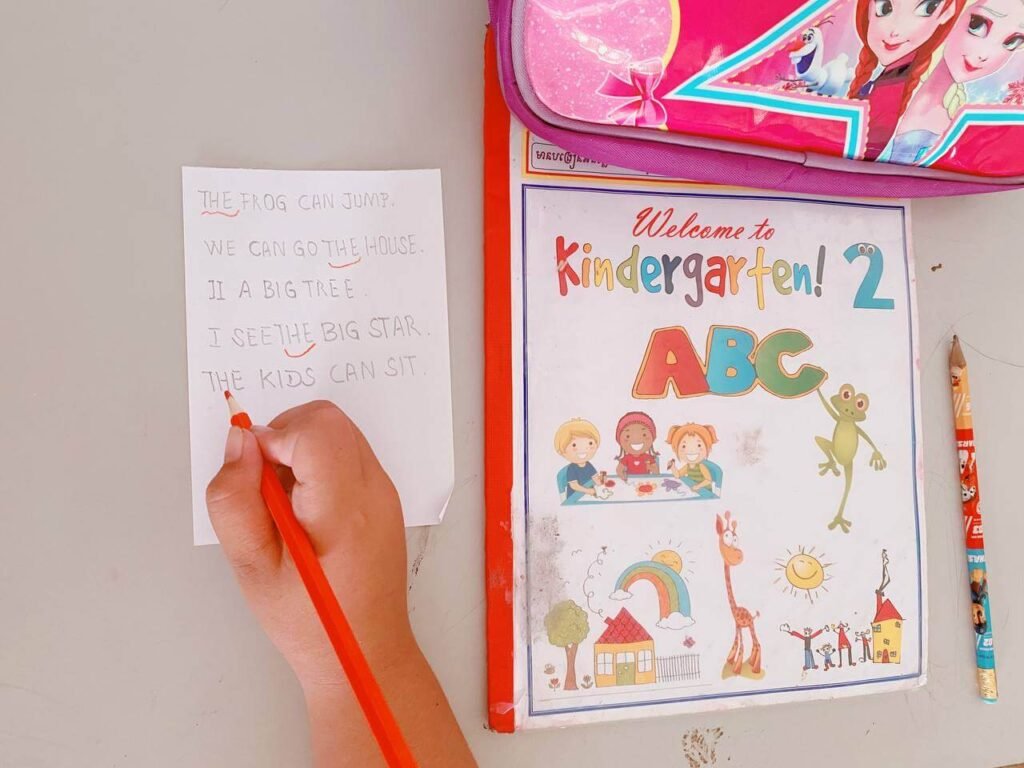
Write three or four sentences underneath it. Hand your child a bright colored pencil or highlighter and have them mark every time they spot “the” or “The” in the sentences.
It’s a quick activity, but it builds the kind of fast word recognition that makes reading feel less like work.
How This Method Builds Reading Automaticity
This part is, in my opinion, the most important piece of the whole approach.
When my daughter first started, I had to prompt her constantly. “Read this sentence.” “What does this say?”
Reading felt like a task I was assigning her, not something she was doing on her own.
Once I started building sentences from the pictures on her own book covers, something shifted.
Before putting her book in her bag each morning, she’d spend about five seconds reading a line like “I see the big sun” and pointing at the picture of the sun.
Later, when she took the book back out, she’d read three to five sentences on her own, things like “I see a green frog,” “I see the funny snowman,” and “I see a red house,” without me asking her to.
That’s reading automaticity in practice. It’s not about drilling more sight words. It’s about repeating familiar sentences often enough, in a low-pressure way, that recognizing them becomes second nature.
I no longer had to push her to read. She just did it.
Pre-K or Kindergarten? This Method Works for Both (K1 & K2)
A lot of parents ask whether this only applies to one grade level. It doesn’t. The structure stays exactly the same for Kindergarten 1 and Kindergarten 2.
The only thing that changes is the length and complexity of the sentence, since a Kindergarten 1 student is usually still working with shorter phrases and fewer sight words.
If your child is younger, just shorten the sentences and stick to two or three words per phrase before building up to full sentences like the ones above.
Final Thoughts
Looking back, the breakthrough wasn’t a new app, a new curriculum, or hours of extra practice.
It was simply matching the sentences to what my daughter was already learning, instead of inventing something new every day.
If you’re looking for a way to teach sight word sentences for kindergarten that actually sticks, start with the book that’s already in your child’s bag.
You’ll likely find that the words she needs to practice were sitting right there on the cover the whole time.
Frequently Asked Questions
Why does my child forget sight words so quickly?
Children forget sight words quickly when the words are practiced as isolated flashcards without a familiar context. Early readers remember words much faster when they see them repeated in a familiar context.
By pulling vocabulary directly from a textbook or workbook they already recognize from their own classroom, you give their brain an instant anchor for memory.
How many sight word sentences should a kindergartner practice each day?
A kindergartner should practice three to five short sight word sentences each day. There is no need to overload your child or turn reading into a chore. The goal is consistency, not volume. In my experience, a focused, five-minute daily session will build confidence much faster than a grueling 30-minute session once a week.
Why should I combine sight words and CVC words in the same sentence?
Teaching them together bridges the gap between memorization and active decoding. Sight words (like the, see, go) have to be recognized by sight because they don’t always follow regular spelling rules.
CVC words (like sun, big, red) follow a strict consonant-vowel-consonant pattern that kids can actively sound out. Putting both in one short sentence keeps your child from guessing blindly while building real reading stamina.
Can I use this method if my child is in Kindergarten 1, not Kindergarten 2?
Absolutely. The exact same activities and worksheet formats apply to both levels. The only adjustments you need to make are shortening the phrases and sticking to simpler vocabulary. Just pull the target words directly from whatever book or handout your child is currently bringing home in their school bag.
Do I need to buy special materials to make these worksheets at home?
Not at all. I made everything featured in this article at my kitchen table using just regular paper, a pencil, and a pair of scissors. You don’t need fancy printables or paid software—recreating these activities by hand takes less than five minutes and works just as well as anything typed on a computer.
