

Disclaimer: The content on Sprout Upward is designed to encourage intentional family leadership. I am a mom of two and a former youth worker sharing my real-life experiences, not a licensed therapist or medical professional. These guides adapt my professional team management background to daily home life. Please consult your pediatrician for any clinical, medical, or psychological advice regarding your child.
When my daughter started Grade 2, her math lessons became more demanding, and homework became something she dreaded.
Most evenings, she would sit at the table with her chin in her hands, looking miserable.
Sometimes she would cry, saying the numbers were too confusing, especially when the lesson involved word problems about dividing fruits or other everyday items.
If you have ever watched your child cry while doing math homework and felt completely helpless, you are not alone.
Math anxiety in kids is far more common than most parents realize, and the frustration your child feels is real, not laziness or a lack of effort.
One Sunday evening, a momentous event occurred in our kitchen, and I want to share it with you exactly as it happened.
Key Takeaways
- Math anxiety in kids is common and often triggered by the pressure of sitting at a desk with a worksheet.
- Changing the setting and framing of a math problem from “homework” to “real-life task” can unlock a child’s thinking almost instantly.
- Repeated attempts and small failures are not setbacks; they are the actual learning process.
- You do not need expensive tools or tutors. A kitchen, some vegetables, and a small budget can teach division better than most textbooks.
- Teaching kids math through everyday cooking and shopping also builds early financial literacy.
- A growth mindset in math begins with how parents respond to failure, rather than the number of problems a child gets right.
Why Does My Child Cry Doing Math Homework?
Before I tell you the story, it helps to understand what is actually going on when a child shuts down during math. It is not about intelligence.
Research consistently shows that children who cry or refuse to do math homework are often experiencing genuine anxiety rooted in how math is presented to them, not their ability to understand it.
The typical homework setup works against a child’s brain.
A silent table, a pencil, abstract numbers on a page, and a parent watching with worried eyes create a pressure cooker.
The moment a child senses they might fail in front of someone they love, the brain shifts into protection mode.
Thinking clearly becomes almost impossible.
The fix is not more practice in the same environment.
The fix is a completely different environment.
Overcoming Math Anxiety: A Practical Example Using Kitchen Groceries
One Sunday evening, while I was cooking in the kitchen, my daughter opened the refrigerator and started playing with a bunch of morning glory she found inside.
I expected my husband to stop her and redirect her back to the homework she had abandoned.
Instead, he did something that surprised me completely.
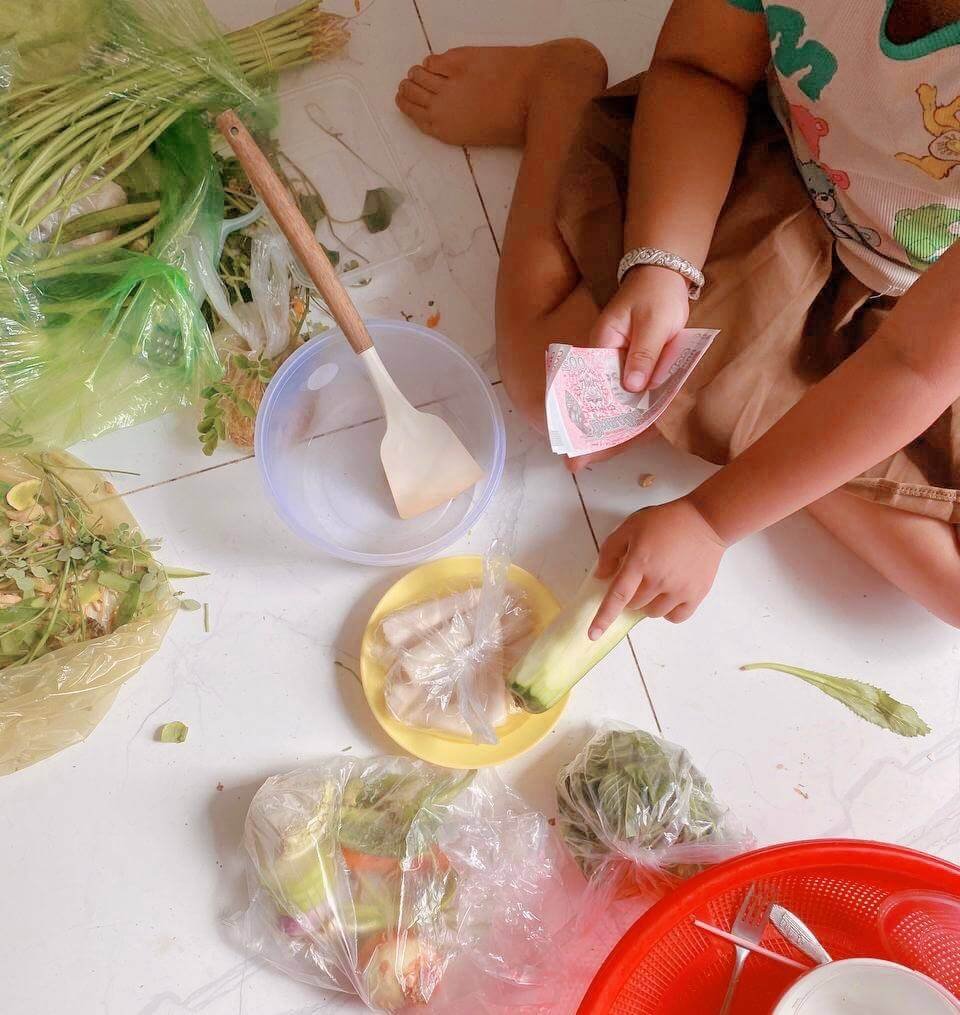
He pulled out other vegetables from the fridge and arranged them around her on the floor.
Then he reached for his wallet and counted out 6,000 Riel in 500-Riel notes, placing the money next to the vegetables.
I walked over and asked why he was letting her scatter groceries all over the house.
Without a word, he handed me her homework book.
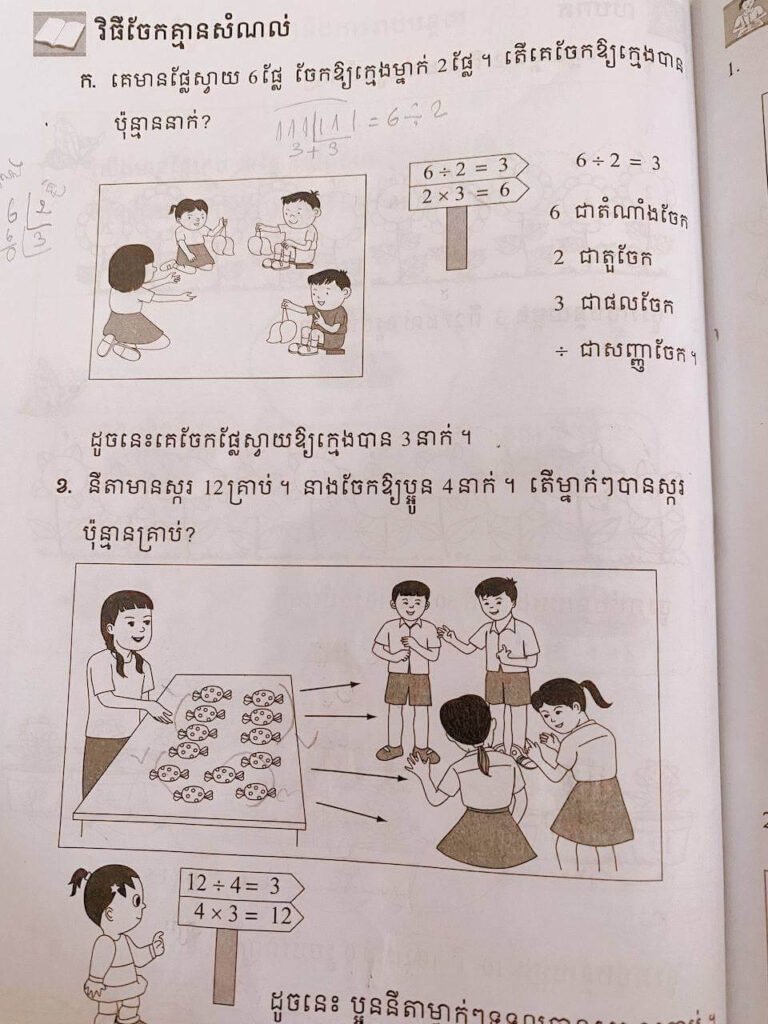
The open page showed a lesson on division with no remainder.
Then he turned to our daughter and said, “I am giving you 6,000 Riel.
How would you divide this money to buy the ingredients for Samlor Chean Chun?”
And just like that, the homework became dinner planning.
Teaching Kids Division Without Worksheets: Three Attempts and One Breakthrough
What followed was not a smooth, instant success. There were three attempts, and each one taught her something.
- The first attempt ended quickly. She tried grouping the vegetables by type and matching money amounts to them, but the combinations confused her. She looked up and said, “Oh, I cannot figure it out!” She stopped, frustrated.
- The second attempt started with her holding the banknotes and trying to physically match them to each vegetable. But the options felt overwhelming. “It is too confusing,” she said, “I cannot get it right!”
My husband noticed she was overwhelmed by the number of vegetables in front of her. Quietly, without making a big deal of it, he removed some to narrow her choices and make the problem easier to visualize.
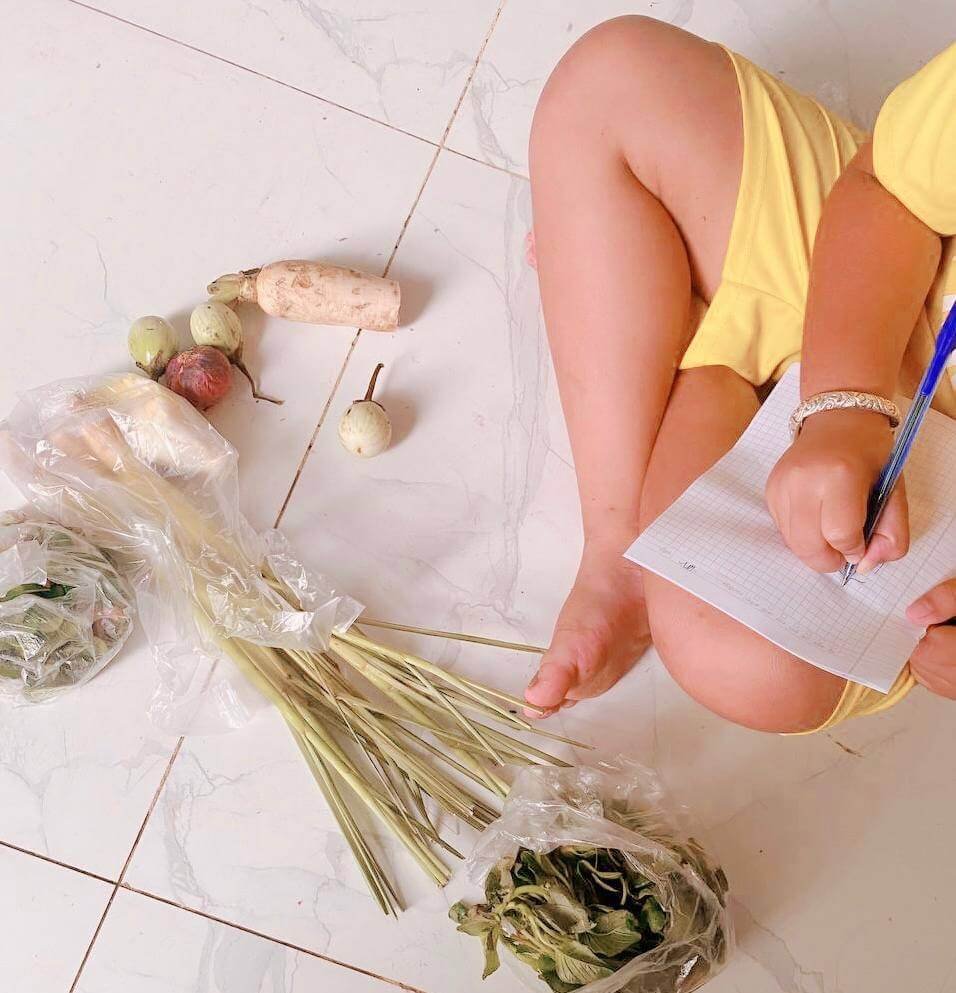
- The third attempt was different in a small but important way. She paused, looked at her skirt, and said, “It is hard to think in this skirt.” She changed into pants, grabbed a pen and paper on her own, and sat back down. She began writing out each vegetable and the cost beside it, working through it systematically, one item at a time.
After a few minutes of quiet writing, she looked up and announced her list:
- Lemongrass: 1,000 Riel
- Amaranth: 500 Riel
- Eggplant: 500 Riel
- Spices: 2,000 Riel
- Total spent: 4,000 Riel, with 2,000 Riel remaining.
My husband leaned forward and said, “With just those ingredients, the soup will not taste very good. What should you do with the leftover money?”
She thought for a moment and replied, “Oh, then we should add cabbage for 1,000 Riel, and buy some ripe fruit for 1,000 Riel to eat after the meal.”
What She Actually Learned That Evening
Let us be honest about the results of that session, because honesty is important.
Could the ingredient list she wrote actually make a proper pot of Samlor Chean Chun? No.
Did the prices she assigned match real market prices? Not at all.
Was the soup plan realistic? Not really.
But here is what actually matters:
- Did she understand how to divide a total amount without a remainder? Yes.
- Did she learn how to allocate a fixed budget across multiple items? Yes.
- Did she stop crying, sit down, and work through a math problem independently? Absolutely yes.
She walked away from that session understanding division in a way that no worksheet had managed to teach her.
The math was real. The stakes felt real.
And for once, the outcome felt like her decision, not just a box to tick on a page.
Real Life Math Activities at Home: Building on This Milestone
What you witnessed in that kitchen story is a well-recognized approach to tackling math anxiety in kids.
By shifting the setting from a desk to the kitchen floor, and by reframing the task from “homework” to “planning dinner,” my husband helped her develop genuine mathematical reasoning instead of memorized steps.
Here are practical ways to keep building on this kind of progress.
Celebrate the Attempts, Not Just the Answers
Remind your child that the first two failed attempts were not failures at all.
They were the process. Scientists, cooks, and engineers all work exactly the same way.
They try, they adjust, and they try again.
When your child hears you say “that was a great first attempt” instead of “that is wrong,” their brain stays open instead of shutting down.
This is the foundation of a growth mindset in math: the idea that effort and adjustment lead to understanding, and that no single wrong answer defines ability.
Make It Low-Stakes and a Little Messy
The moment a child feels the weight of “getting it right,” anxiety creeps back in.
Vegetables on the kitchen floor, coins on a table, fruit at a market stall, these are low-stakes environments.
Mess is fine. Wrong answers are fine.
The goal is thinking, not performance.
Keep cooking lessons fun, slightly chaotic, and pressure-free, and you are training your child’s brain to associate math with creativity and problem-solving rather than fear and judgment.
Use the “Why” as Much as the “How”
Notice what my daughter did with the leftover 2,000 Riel. She did not just leave it.
She decided to use it for cabbage and fruit.
That is resource allocation, a higher-order thinking skill.
She figured out the “why” on her own before anyone asked her to.
When your child shows this kind of reasoning, praise the logic loudly. “I love how you thought about using every single Riel.
That is exactly how smart people plan.” Praise the thinking, not just the arithmetic.
Financial Literacy Kids Activities at Home: The Next Step
This is where hands-on math learning pays a second dividend.
Since the ingredient list and the prices were not realistic for an actual market trip, there is a natural and exciting next lesson available to you.
Take your child to the local market with a small, fixed budget. In our case, something like 5,000 Riel is enough to make it feel real without any pressure.
Let your child be the accountant.
Give them the responsibility of checking whether the real market prices match what they planned. Let them make adjustments when they do not.
This is a real-life math activity in action, and it teaches far more than any worksheet can.
Your child learns:
- How to compare prices and make decisions
- That planning and reality often differ, and that is normal.
- How to adjust a plan on the go
- Those numbers have actual meaning beyond a score on a test.
These are the building blocks of financial literacy, and they start at market stalls and kitchen floors, not in financial literacy textbooks.
Turning Homework Failures Into Learning Moments: A Simple Framework
If you want to apply this approach consistently, here is a simple framework you can use at home.
Step 1. Spot the shutdown
When your child goes quiet, starts fidgeting, or says, “I can’t do this,” that is the signal. Do not push harder. Change something, the setting, the framing, or the materials.
Step 2. Make it physical
Bring in objects that can be counted, grouped, or divided. Coins, fruit, toys, building blocks, anything that turns an abstract number into something your child can touch and move.
Step 3. Give them a role
Instead of “solve this problem,” try “you are in charge of the shopping budget” or “you are the one deciding how to split this fairly.” Ownership changes everything.
Step 4. Name the wins along the way
When they make a second or third attempt after failing, name that specifically. “You just did what scientists do. You tried again. That is the skill.”
Step 5. Let reality teach the lesson
If the plan does not work out perfectly, that is the point. Let your child feel the gentle gap between their plan and reality. That gap is where real learning lives.
Conclusion: Math Anxiety in Kids Does Not Need a Tutor
The evening my daughter sat on our kitchen floor, surrounded by morning glory and 500-Riel notes, nobody sat down and explained the algorithm for division.
Nobody drilled her with flash cards. Nobody pointed at a textbook diagram.
A few vegetables, a small handful of cash, and a dad who asked a simple question did what weeks of worksheets had not managed to do.
Math anxiety in kids is very often a signal that the child needs a different approach, not more of the same.
When the environment changes, when the problem feels real, and when failure is treated as part of the process rather than proof of inability, children can surprise you completely.
Tonight, try one small thing.
Let your child count the change from dinner. Let them divide the biscuits fairly between siblings.
Ask them to help you figure out how much something costs at the market.
Start small, stay relaxed, and watch what happens.
The kitchen is one of the best math classrooms you already own.
Common Questions About Navigating Math Anxiety at Home
Why does my child cry while doing math homework, even though they are smart?
Math anxiety has very little to do with intelligence. Smart children cry during math homework because the pressure of performing correctly in front of a parent, combined with abstract numbers on a page, triggers anxiety.
The brain under stress struggles to access logical thinking. Changing the setting and removing the pressure often solves this faster than extra tutoring.
At what age does math anxiety in kids usually start?
It can begin as early as Grade 1 or Grade 2, which is when math shifts from counting to more abstract operations like addition with regrouping and simple division. This is also the age when children become more aware of being “wrong” in front of others, making the anxiety worse.
How do I teach kids division without worksheets?
Use everyday situations that involve splitting things equally. Dividing snacks between family members, splitting a budget to buy market ingredients, or sharing coins fairly between siblings all require division thinking. The key is to give your child a real role in the task, not just ask them to watch.
My child gets anxious the moment I sit next to them for homework. What should I do?
Try stepping back physically and giving your child more independence. Sometimes parental presence during homework increases pressure, especially if the child senses your anxiety about their performance.
Set up the task, offer help only when asked, and praise the effort regardless of the result. A relaxed parent helps create a relaxed learner.
