

Disclaimer: The content on Sprout Upward is designed to encourage intentional family leadership. I am a mom of two and a former youth worker sharing my real-life experiences, not a licensed therapist or medical professional. These guides adapt my professional team management background to daily home life. Please consult your pediatrician for any clinical, medical, or psychological advice regarding your child.
Every school morning at our house felt like a small disaster unfolding in slow motion.
I would call for my daughter to wake up, and before she even made it to the kitchen, something was already wrong. “Mom, I forgot my books!” “Mom, I forgot my water bottle!” The panic in her voice was real, and so was my exhaustion.
I was constantly trying to catch my breath, help her find her missing things, and still get everyone out the door on time.
If you’ve been looking for a morning routine checklist for a 7-year-old that actually sticks, I want to share what finally changed things for us.
Because the answer was not what I expected at all, and the solution did not come from me. While this DIY chart fixed our biggest morning hurdle, it is just one of the 8 strategies our family uses to get out the door without yelling.
Key Takeaways
- A morning routine checklist works best when your child helps design it, not just follow it.
- Too many visual cues can overwhelm young children, not organize them.
- Placing the chart on a bedroom door creates a natural checkpoint that they cannot skip.
- For children aged 6 to 8, three to five tasks is the right number. More than that becomes noise.
- The goal is not perfect execution every day. The goal is for your child to understand the process and feel responsible for it.
The Wall Full of Charts That Changed Nothing
I thought I was doing everything right.
I printed colorful charts, laminated them, added pictures and symbols, and covered the walls of our home with visual schedules. I was proud of the effort, genuinely.
I had read that visual routines help children, so I made as many as I could. I thought that more detail meant more clarity.
But the chaotic school mornings continued. My daughter still forgot her water bottle.
She still panicked about her school bag. And I was still the one reminding her of every single step, every single morning.
I know I am not alone in this. So many parents try exactly this, putting in real effort and seeing very little change.
The Morning My Husband Took Down Every Chart
About two months into the wall-chart experiment, my husband did something that genuinely shocked me.
He walked around the house and quietly took down every single chart. All of them.
I was annoyed—mostly because of all the hours I’d spent laminating them. When I asked him what he was doing, he just told me he had an idea and asked me to trust him until Sunday.
The following Sunday, the three of us sat together in our daughter’s playroom. My husband had a small whiteboard and a marker.
He drew a simple table with the days of the week across the top. Then he looked at our daughter and asked her a question I had never thought to ask:
“Why do you keep forgetting your water bottle at school?”
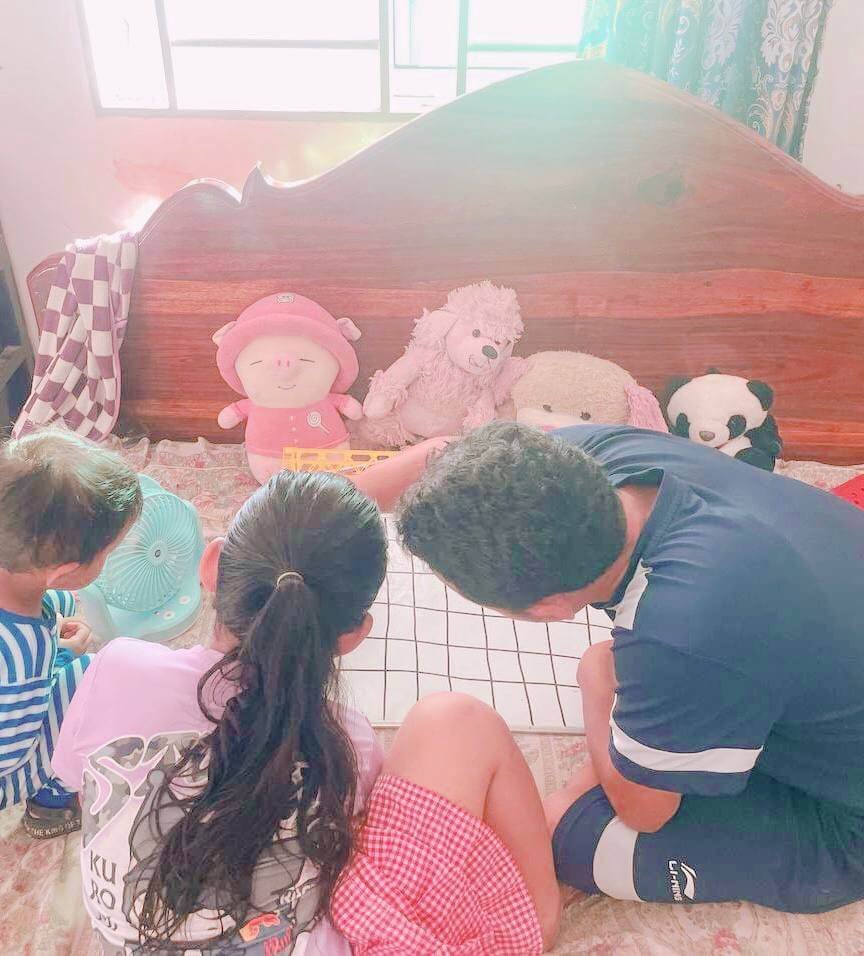
She looked at him for a moment, then said something that changed everything for me:
“It’s too much. The charts on the wall are too cluttered, and I don’t know what the pictures are supposed to mean.”
Those words were a wake-up call. What I had believed was helpful was actually just confusing noise to her.
How We Created a Morning Routine Checklist Our 7-Year-Old Actually Uses
After hearing what our daughter said, my husband handed her the marker.
“We made the table,” he told her. “Now let’s make it easy. Draw three things you want to do first.”
What happened next still amazes me when I think back to it.
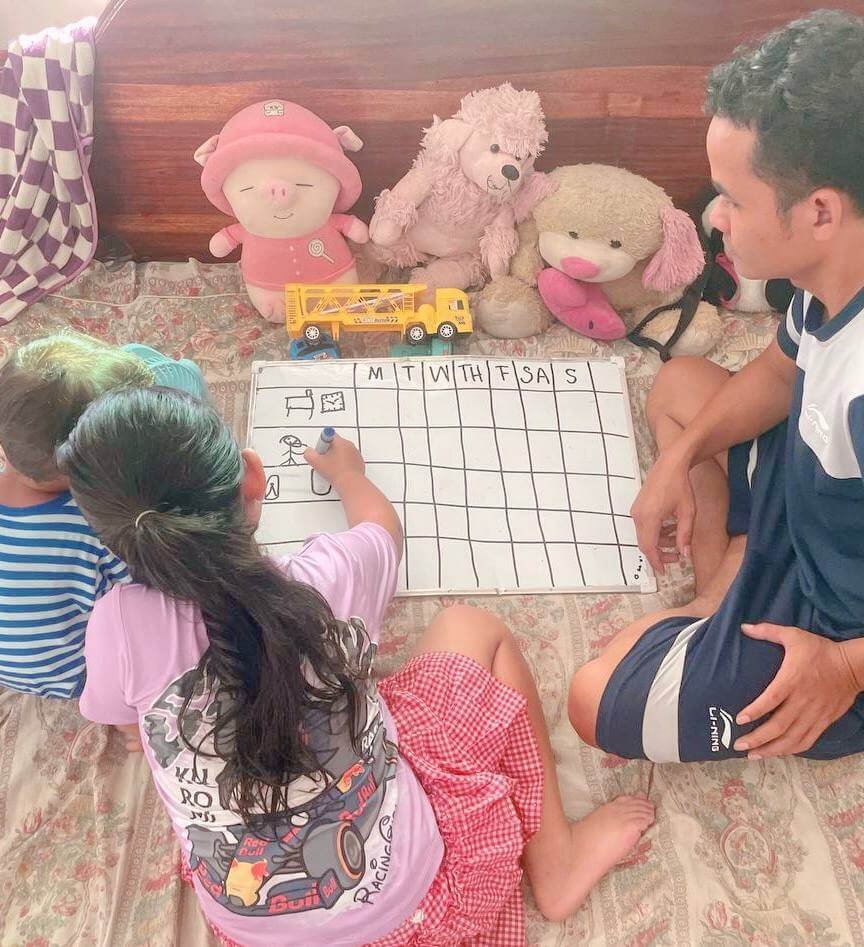
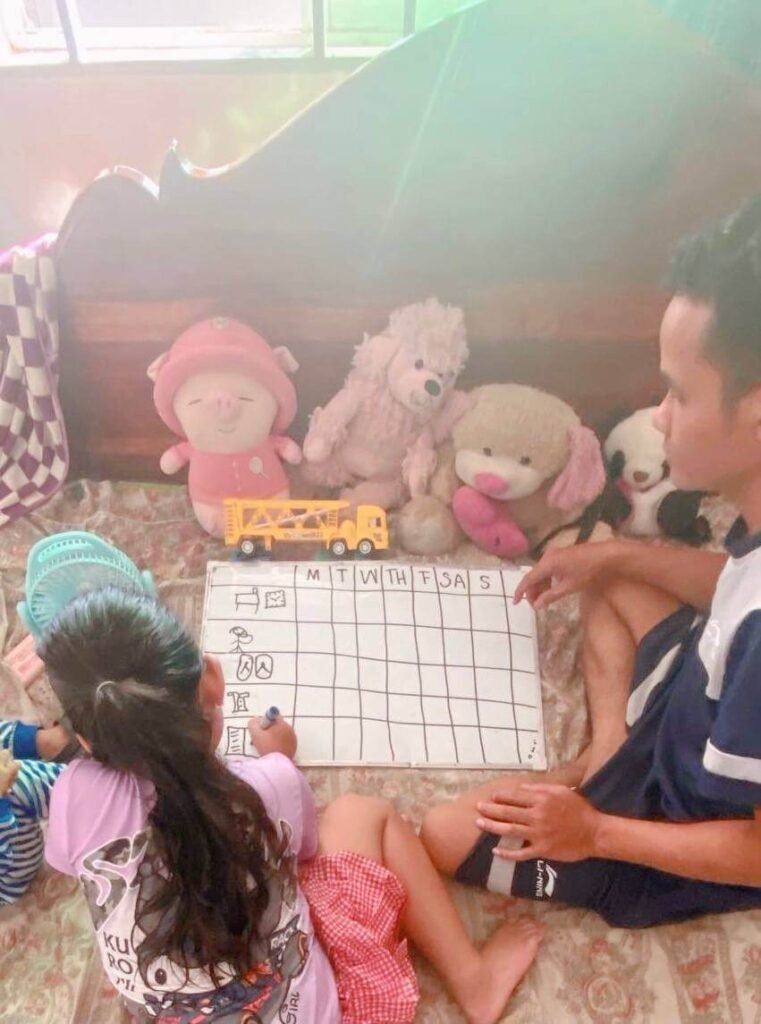
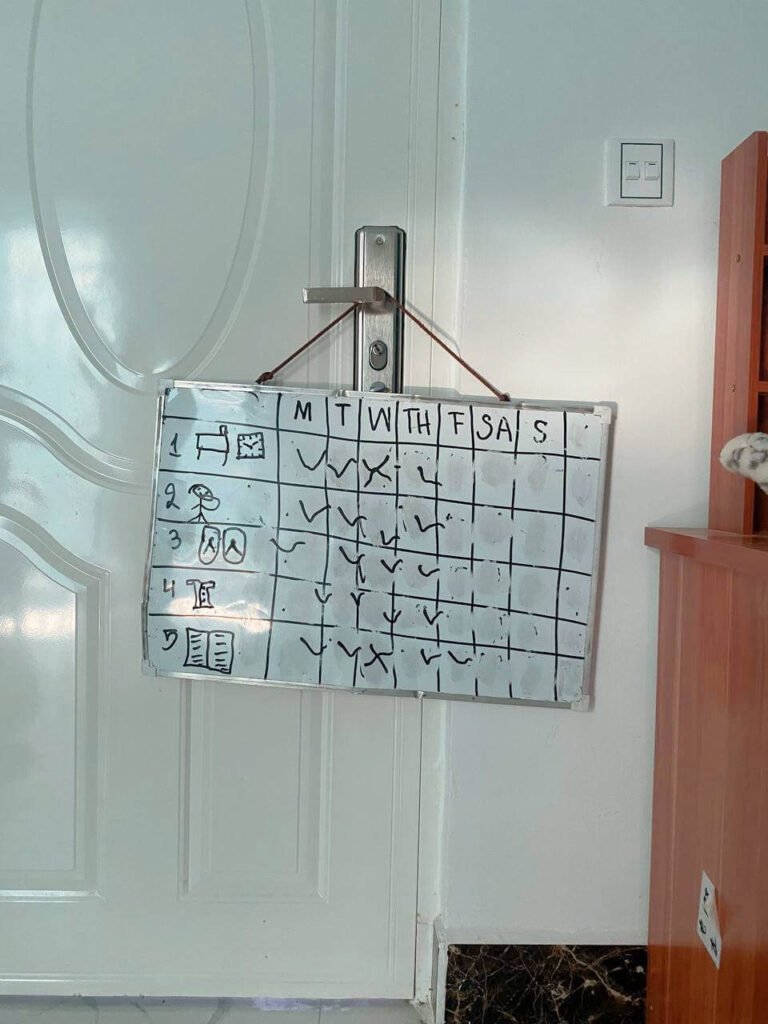
She took the marker and started drawing without hesitation. She drew a bed and a clock to represent her wake-up time.
She drew a stick figure touching its mouth to show brushing her teeth and washing her face.
She drew a pair of shoes for putting on her footwear, a shirt to represent her school uniform, and a stack of books to remind her to check her bag.
When we asked about the water bottle and the lunch box, she looked up calmly and said, “Mom, you always have those ready for me.”
She was completely right. And that was the moment I realized I had been mixing up her responsibilities with mine.
I had put my tasks on her chart and then wondered why she felt overwhelmed.
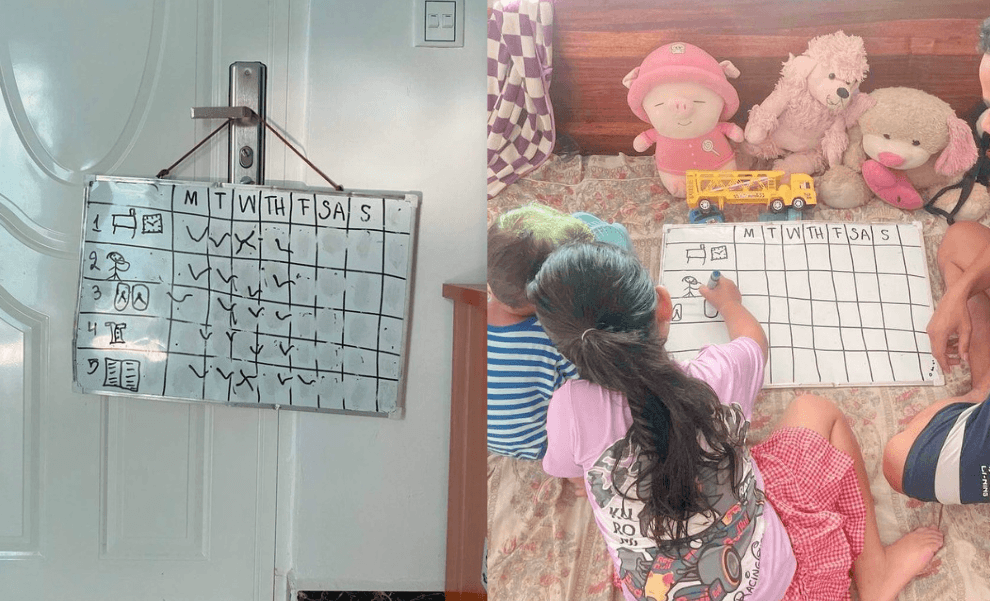
The entire chart came from her. Five simple picture icons. One row per task. Seven columns for the days of the week. Nothing more.
The Bedroom Door Became Her Checkpoint
We hung this new, simplified chart directly on her bedroom door handle.
That one detail turned out to matter more than anything else. The door became a natural checkpoint in her morning.
She cannot open the door and walk into the hallway without passing directly by the chart.
So every morning, before she even touches the handle, she checks her list, works through her tasks, and marks a tick beside each one she completes.
It became a quiet ritual. A self-directed habit that she owns completely.
Is She Perfect Now? No, and That Is Okay
She does not tick every box every morning. Some days she misses a step. Some mornings she rushes out without marking anything at all.
But something far more important has changed. She understands the process now.
She knows the order: wake up, take care of hygiene, get dressed, check her bag, then leave the room.
She no longer waits for me to remind her of each step, because she has internalized the sequence herself.
Looking back at the old charts covering the walls, did she ever truly understand her responsibilities?
No. But with this new chart, one she designed herself, she understands exactly what she needs to do and why.
That is the goal. Not a child who follows instructions perfectly, but a child who understands the logic of her morning and takes responsibility for it.
Why This Approach Actually Worked
As a mother who has now watched this system in action, here is my honest understanding of why my husband’s approach made such a difference for our daughter.
She had ownership of the chart
Because she drew the pictures herself, the schedule became her creation. A child around 7 or 8 years old is at a stage where they want to feel capable and independent.
When she drew the “books” icon, it became her own reminder to herself, not an instruction from a parent telling her what to do.
That shift changed how she responded to the chart completely. She was not following someone else’s rules. She was following her own plan.
A simpler list reduced the confusion
Her exact words were that the old charts were “too cluttered.” Young children who are in their first or second year of school are still building the mental skills needed to manage multiple pieces of information at once.
When there are too many visual tasks competing for attention, the chart does not help the child focus. It often causes the opposite reaction.
By narrowing everything down to five essential steps, she could look at the chart and immediately know what to do, without having to decode anything.
The door created a habit trigger she could not avoid
My husband’s decision to hang the chart on the bedroom door was genuinely clever. The door is something she must physically interact with every single morning in order to leave her room.
That makes it impossible to overlook. Over time, checking the chart before opening the door became automatic.
Repeated daily actions like this, linked to a physical cue, are exactly how habits form in children and adults alike.
She moved from following rules to understanding a process
Before this chart, she was expected to comply with a list of tasks. Now she understands the flow behind those tasks.
She sees the logic that connects each step: wake up, then hygiene, then getting dressed, then checking her bag, then leaving the room.
That understanding is what makes the routine stick even on the mornings when she is tired, distracted, or running a few minutes behind.
How to Try This With Your Child
If you are dealing with stressful school mornings and wondering how to get your kids ready for school without the daily struggle, here is a simple version of what we did.
- Sit down together without an agenda. Do not frame it as “fixing” your child or their bad habits. Frame it as solving a problem as a team. Children respond very differently when they feel like a partner instead of a subject being corrected.
- Ask open questions. What makes mornings hard? What do you keep forgetting? What would help? Let your child identify the problem in their own words. You might be surprised, the way we were, at how clearly they can see what is and is not working.
- Let them draw or write the checklist themselves. Even if the drawings are messy and unclear to you, they will make perfect sense to your child, because your child created them. That personal meaning is the whole point.
- Keep the list short. Three to five tasks is the right range for children aged 6 to 8. Anything beyond that begins to feel like too much to process on a rushed morning.
- Put the chart somewhere they must physically pass before leaving a space. A bedroom door, a bathroom mirror, or the inside of their wardrobe door all work well. The key is that they encounter it naturally, not as something they have to remember to go check.
- Then let it be theirs. Resist the urge to add more tasks, redesign their icons, or improve the layout. The power of this system comes from your child’s ownership of it. The moment it becomes yours again, it loses that power.
The Simplest Fix Was Giving Her the Marker
For months, I believed the answer was more structure, more charts, and more reminders. It turned out the opposite was true.
What my daughter needed was a morning routine checklist she had actually made herself, one with only the tasks that were genuinely hers, placed exactly where she could not miss them.
The chaos did not end because I added something to our mornings. It ended because we stripped everything back, sat on the floor together, and asked our daughter what she needed instead of assuming we already knew.
If your school mornings feel like a battle right now, try handing your child the marker. You might be surprised at how clearly they understand what they need, once you stop explaining it for them.
FAQ: Morning Routine Checklists for School Kids
At what age is the best time to start a morning routine checklist for kids?
Most children can follow a simple picture-based chart from around age 4 or 5, when they can recognize images and understand simple sequences. By ages 6 to 8, children are ready to actively participate in creating their own chart, which makes them far more likely to actually use it each day.
Why does my child keep forgetting things for school?
Forgetting school items is a normal sign of developing executive functioning skills, not carelessness. Children aged 6 to 8 are still learning to juggle multiple mental tasks at once. If they constantly miss items, it usually means the visual system in place is too complex for their current cognitive load.
Should I make the morning routine chart for my child, or should they make it?
Letting your child help create the chart is far more effective than making it for them. When children have a hand in designing their own morning chart, they feel a sense of ownership over it. That ownership makes them significantly more likely to use it consistently. Your role is to guide the process with questions, not to provide the answers.
How many tasks should be on a morning checklist for a 7 or 8-year-old?
A morning checklist for a 7 or 8-year-old should strictly contain only three to five tasks. Keeping the list short prevents early-morning overwhelm. Focus entirely on their personal responsibilities—like hygiene and checking their school bag—while keeping parental tasks like packing lunches off their plate.
What if my child doesn’t follow the chart every single morning?
That is completely normal and is not a failure. The goal is not perfect compliance. The goal is growing independence and a gradual understanding of the morning process. Over time, consistency builds. Acknowledge the effort and the progress, not just the days they tick every box.
Where is the best place to hang a morning routine chart for kids?
The best place to hang a morning routine chart is directly on your child’s bedroom door handle. This creates a physical checkpoint that they must interact with before leaving the room. Avoid hanging it high on a wall where it easily blends into the background decor.
Does this approach work for kids who forget their school things regularly?
Yes, and it works specifically because it removes the parent from the equation. When the chart is the reminder rather than a parent’s voice, it stops being a power struggle. The child is checking their own system, not obeying a repeated instruction. That difference in framing changes how most children respond.
